
Is Italy gay friendly?
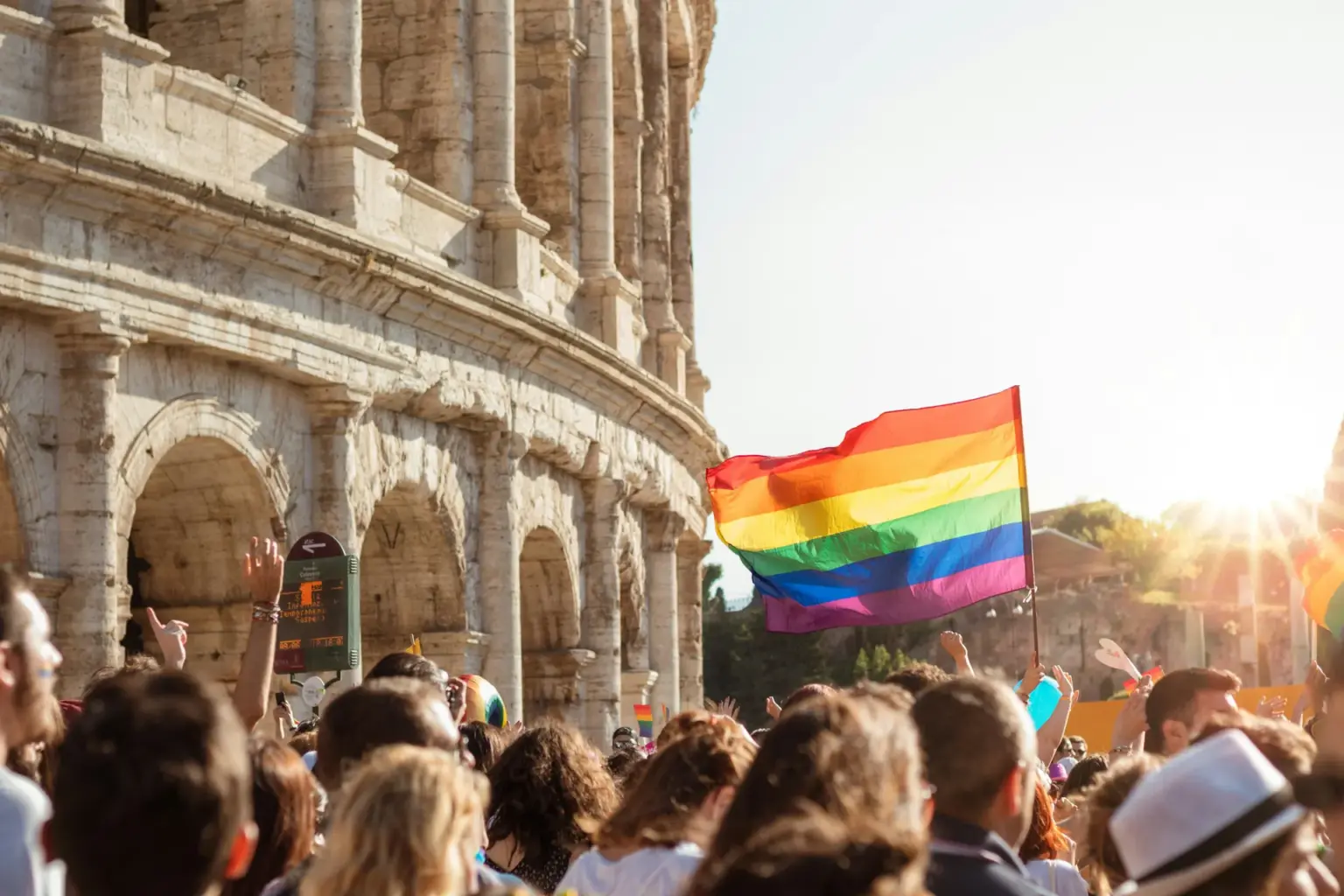
Yes — Italy is a warm, easy country for gay travelers, and far more welcoming than its headlines suggest. The honest answer has two sides. On paper, Italy lags behind much of Western Europe: it recognizes same-sex civil unions, not marriage, and it sits 36th of 49 countries in ILGA-Europe’s 2026 Rainbow Map. On the ground, 73% of Italians support same-sex marriage, every large city has its own LGBTQ+ neighborhood, and the South — the part of the country Americans ask me about most — is far more open than its reputation. I’m Italian, and this is the gap I explain to clients every week. At Gay Up Travel I plan tailor-made trips across Italy built around the places, stays and rhythm where you can simply be yourselves.
What the law says
Let me be straight with you, because the details matter. Italy introduced same-sex civil unions in 2016. They give couples most of the protections of marriage, but same-sex marriage is not legal, and parenthood is not automatically recognized for same-sex couples. Discrimination at work has been banned nationally since 2003, and several regions — among them Campania, Sicily and Puglia — have added their own anti-discrimination laws. A national hate-crime law, on the other hand, stalled in the Senate in 2021.
That is why Italy ranks 36th in Europe. The ranking reflects the conservative turn of national politics in recent years, not the way people live. The courts have kept moving: in 2025 Italy’s Constitutional Court ruled that both mothers can be registered as parents of a child born through IVF abroad.
What it actually feels like: people, not politics
Here is the part the rankings miss. There is a real gap between what Italy’s governments decide and how Italians feel — and the people are much more welcoming than the media story. In Pew Research’s 2023 survey, 73% of Italian adults favored same-sex marriage, even though it isn’t legal. In 2025, Ostuni, a town of around 30,000 in Puglia, held its first Pride, with the mayor calling it a historic day.
In the places travelers actually go — a hotel terrace, a restaurant in the old town, a boat along the coast — two men together read as ordinary. As anywhere in the world, trust your instincts and your common sense: if a place or a moment doesn’t feel right, move on. That’s city sense, not an Italian warning.
The North and the big cities
Every major Italian city has a neighborhood where the community gathers. In Rome, it’s the so-called Gay Street, the stretch of Via di San Giovanni in Laterano a few steps from the Colosseum. In Milan, it’s Via Lecco and the streets around Porta Venezia. Milan and Bologna have long been at the heart of Italy’s LGBTQ+ rights movement, and both feel it: open, confident, and used to difference.
For a first trip, Rome, Florence and Venice are as easy as it gets — international, cultured, and entirely relaxed about couples of every kind. Here’s how I shape Rome, Tuscany and Venice into one journey.
The South: forget the myth
The question I hear most is whether southern Italy is less welcoming. It isn’t — and this is the myth I most want to retire.
- Naples has one of the oldest traditions of openness in Europe, from the femminielli of Neapolitan popular culture to the gay-friendly evenings around Piazza Bellini. Is Naples safe for gay travelers? · Is the Amalfi Coast safe for gay couples?
- Puglia twice elected an openly gay regional president, Nichi Vendola (2005–2015). Bari holds a regular Pride, with local institutions marching alongside the community; there are Prides in Taranto and Ostuni too. In summer, Gallipoli becomes the region’s LGBTQ+ meeting point, and even Lecce, a small city, has its own gay bars. Is Puglia safe for gay travelers? · When to visit Puglia
- Sicily is warm and welcoming, above all in Palermo and Catania, with Taormina a relaxed resort for international couples for over a century. Is Sicily safe for gay travelers? · Where to stay in Sicily
If the South is calling, these are the journeys I build there: Naples, Capri and the Amalfi Coast, Puglia and Sicily.
What we tell our clients before they go
- You do not need to hide. In the places I send you, behave exactly as you would at home.
- Read the country by its people, not its rankings. The politics are real; so is the everyday welcome.
- Book stays that were vetted for you. For me, a verified welcome is the first filter, before view or price.
- Shoulder season is Italy at its best — May, June, September and October bring warm weather, open terraces and fewer crowds.
FAQs
Is Italy safe for gay travelers?
Yes. Italy is a warm and easy country for gay travelers and couples. Same-sex civil unions have been legal since 2016, 73% of Italians support same-sex marriage (Pew Research, 2023), and every major city has an LGBTQ+ neighborhood.
Is same-sex marriage legal in Italy?
No. Italy recognizes same-sex civil unions (since 2016) but not same-sex marriage. Couples can travel and celebrate freely, but a legally binding wedding must take place where same-sex marriage is recognized.
Why does Italy rank low on LGBTQ+ rights in Europe?
Italy ranks 36th of 49 in ILGA-Europe’s 2026 Rainbow Map because it has no marriage equality, no automatic recognition of same-sex parents and no national hate-crime law. The ranking reflects national politics more than public attitudes, which are largely accepting.
Is southern Italy gay friendly?
Yes. Naples has a long tradition of openness, Puglia twice elected an openly gay regional president and holds Prides in Bari, Taranto and Ostuni, and Palermo and Catania in Sicily are welcoming cities. Gallipoli is Puglia’s summer LGBTQ+ hub.
Where are the gay neighborhoods in Italy?
Rome’s Gay Street near the Colosseum, Milan’s Via Lecco and Porta Venezia area, and the Piazza Bellini area in Naples are the best known. In summer, Gallipoli in Puglia draws the community from across the South.
If you’re imagining Italy as a couple — North, South, or both — tell me what you have in mind and I’ll shape it around you. I read every message myself. — Francesco