
What Berlin Holds
A city that is never finished
I have known Berlin for more than twenty years, and I have never once arrived to find it finished.
In 2015 I spent four straight months there for a work project — long enough to stop being a visitor. That is a particular kind of luck. Four months is enough time to learn a city the way you learn a person: its moods, its shortcuts, the streets that change character once the light goes. Since then I have gone back almost every year, sometimes more than once, and one thing has never changed. Berlin is always in motion. There is always a crane on the skyline, always a façade under scaffolding, always a corner that was one thing last spring and is quietly becoming another.
A city that restless could feel exhausting. Berlin doesn’t — and on this last visit, a week in late April with weather that was almost suspiciously kind, I think I finally put my finger on why. Berlin changes constantly, but it almost never erases. It builds the new thing without razing the old one. It lets the past stay in the room.
Reading a place — working out what it is actually made of, underneath what it shows you — is the part of my work I care about most. And Berlin, this time, kept handing me the same lesson in different forms, until I had no choice but to write it down.
A railway that became a park
The clearest version of that lesson is a park called Park am Gleisdreieck, a few minutes from Potsdamer Platz.
It sits on land that spent a century as railway. This was once a tangle of freight yards and track — the approaches to the old Anhalter and Potsdamer terminals, among the busiest in Europe before the war. Afterward the trains thinned out and the land was left to itself for decades, long enough for wild vegetation to quietly take it back. When the city finally redesigned it as public space — built in stages, the bulk of it opening between 2011 and 2014 — it did something I find genuinely moving in its restraint. It did not pretend the railway had never been there.
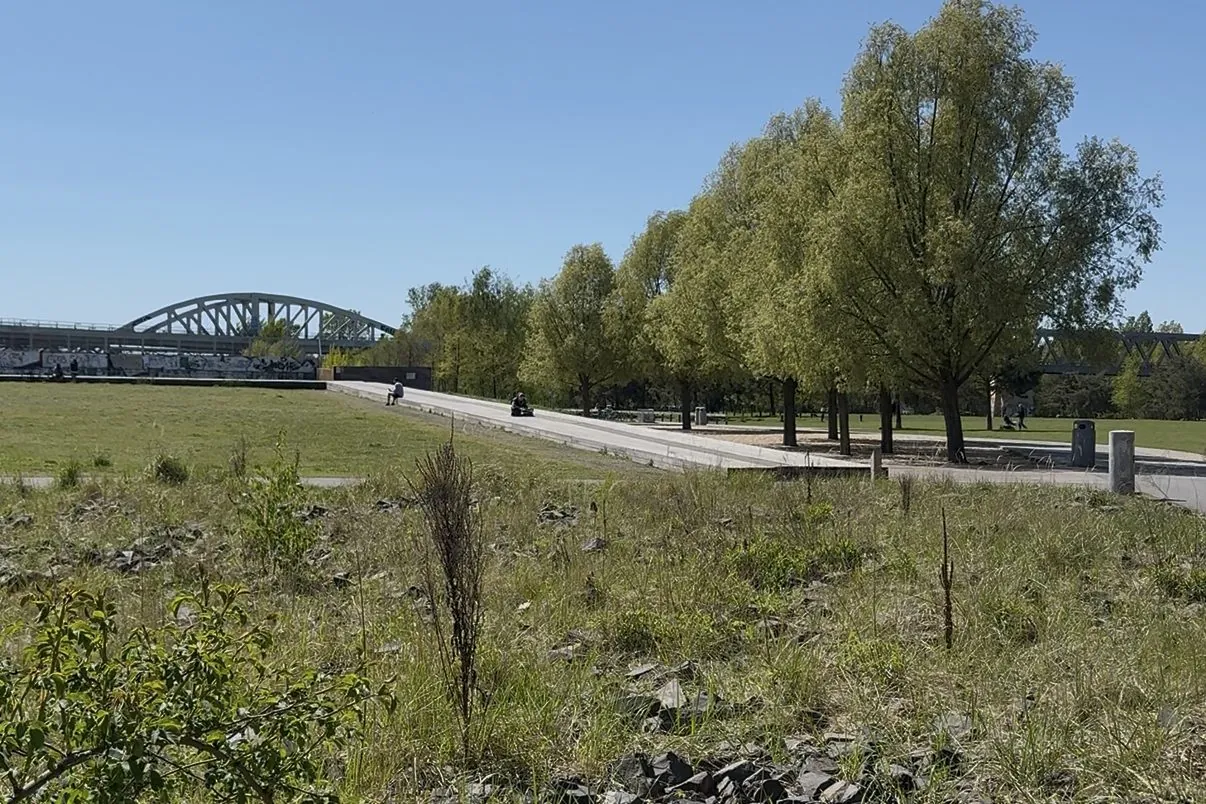
The old rails are still set into the ground. Signal posts still stand. The long, straight geometry of a rail corridor is still the geometry of the park — you walk the line a train would have walked. Around it now there are meadows, terraces, long benches, people stretched out in the sun, others doing their exercises, a small friendly bar partway along. It is right in the center of the city and it feels like open country.
That is the move I keep coming back to. Berlin did not erase the railway to build a park. It let the railway become a park — kept the form, changed the use. Once you have watched the city do that once, you start seeing it everywhere.
It also explains something about how Berlin breathes. For a city of millions, it is astonishingly green: parks threaded through every district, avenues lined with trees, sun reaching the pavement. Berlin is one of the greenest capitals in Europe, and it stays that way partly because it keeps finding room in the seams the past left behind.
A burger inside a public toilet
The same instinct, in a smaller and far funnier package, is waiting under an elevated U-Bahn line in Kreuzberg — the most eccentric district in Berlin, and the one I would send anyone to first if they wanted to feel the city’s nerve.
There is a place there called Burgermeister. Today it is something close to a Berlin institution — the original location of what has since grown into a small chain, serving, I will say plainly, some of the best burgers I have eaten anywhere. What it used to be is a public toilet: a genuine early-twentieth-century municipal lavatory, heritage-protected, tucked beneath the train tracks at Schlesisches Tor. Rather than demolish it, someone in the early 2000s persuaded the city to let them cook in it.
And here is the detail I love. They kept the signs. The old plates reading Frauen and

Männer — women, men — still mark what were once the two entrances. Nobody scrubbed them off. They are part of the place now, the way the rails are part of the park.
I had a small piece of luck of my own here. Burgermeister almost always has a line; it is that kind of address. I happened to arrive at an odd, in-between hour and found it nearly empty, which gave the whole thing a slightly unreal quality — a quiet, near-perfect burger eaten inside a former public convenience, under a rumbling train, in the eccentric heart of Kreuzberg.
Afterward I did what you should always do there: I walked the few minutes down to the Spree. Berlin’s river does not perform for you the way some European rivers do — it simply works, broad and unhurried. Glass towers rise along this stretch, one of them wearing the Mercedes star, and after dark their lights lie flat across the water. It is not a postcard. It is better than a postcard, because nobody arranged it for you.
The museum that keeps the hard pages
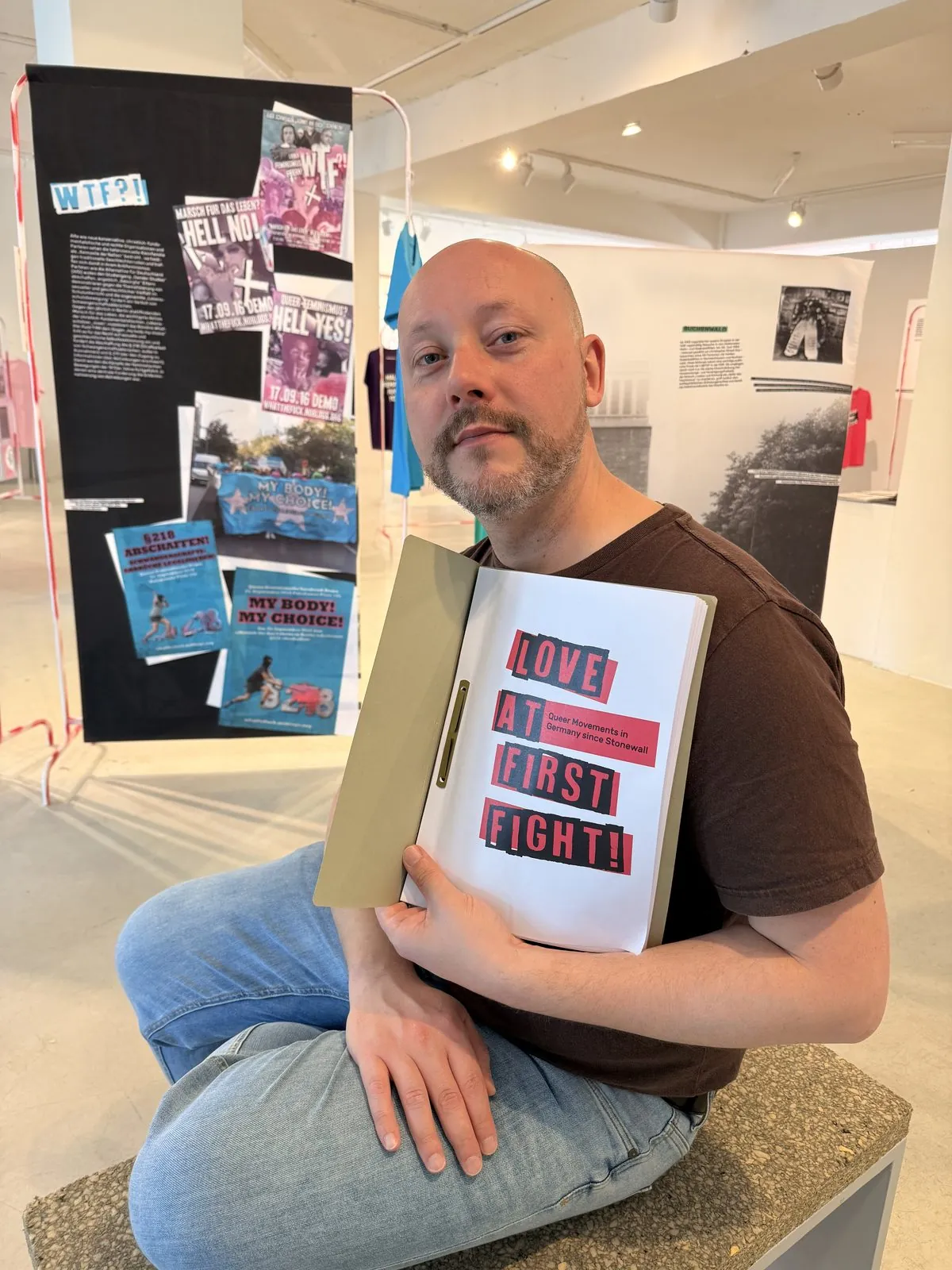
Walk on from Kreuzberg and you reach Schöneberg — and a short way in, technically just over the line in Tiergarten, a building that gave me the most serious hour of the week.
The Schwules Museum, Berlin’s museum of gay history and culture, opened in 1985, and when it did it was the first museum anywhere in the world dedicated to queer life. That fact alone is worth sitting with. Its current home is a converted printing works, and the exhibition we saw was beautifully done — not loud, not lurid, simply intelligent and patient.
What it lays out is the long, tangled history of the struggle for LGBTQ+ rights — in Germany, and braided right alongside it the parallel histories elsewhere, the United States very much included. Decades of publications, of organizing, of small advances and hard reversals, all of it kept, and shown.
And then there is the chapter the museum does not soften, and should not. Under the Nazi regime, gay men were hunted. Paragraph 175 — the law criminalizing sexual relations between men — was sharpened in 1935 and turned into a weapon. Police kept registers. Tens of thousands of men were convicted under it. Thousands were sent to concentration camps, made to wear the pink triangle, and a great many of them never came home. This was one persecution among the many that regime carried out — each its own catastrophe, none to be folded into another — and the museum holds it exactly that way: as a history that deserves to be told in full, in its own right, with its own names.
It was a moving visit. Not a comfortable one — it is not built to be. But I walked out carrying the same thought the park and the burger joint had been circling all week, only heavier now. This city does not erase its history. Not even the unbearable parts. Especially not those.
Schöneberg, still the rainbow quarter
It matters that the museum sits where it does, because Schöneberg has been the heart of queer Berlin for a very long time — and, unlike so much else in this restless city, that has not moved.
Around Nollendorfplatz the neighborhood still announces itself: rainbow flags, rainbow-marked storefronts, an ease in the air you register within a block. But the depth of the place is what makes it more than a district with good bars. A century ago this was already the city’s gay quarter — the Berlin of the late 1920s, brilliant and precarious at once. In 1929 a young English writer, Christopher Isherwood, took a room on Nollendorfstraße, steps from the square, and stayed until 1933. What he saw in those years became Goodbye to Berlin — and, in time, the world the musical Cabaret was built from. A plaque on the building still marks where he lived.
And on the exterior wall of the Nollendorfplatz U-Bahn station there is something I think every traveler should stop in front of: a pink triangle memorial, placed there back in the 1980s, among the first public monuments anywhere to name the homosexual victims of National Socialism. It is mounted on a working train station. Commuters pass it every morning. The city chose to carry that memory in plain sight, on the way to work — not sealed inside a museum, not pushed to the edge of town. On the wall, where everyone is.
The neighborhood today is, of course, also simply alive. Berlin has never been a city afraid of desire, and Schöneberg reflects that honestly, with a nightlife that runs the full spectrum — from the gentle to the frank, from a quiet glass of wine to whatever you came looking for. I will say that the way one adult says it to another, and leave the cataloging to people with duller things to do. The point is the ease. Schöneberg is, frankly, one of the few neighborhoods anywhere I would happily choose to stay in myself — not for any single address, but for the temperature of the streets.
The myth of the cold German
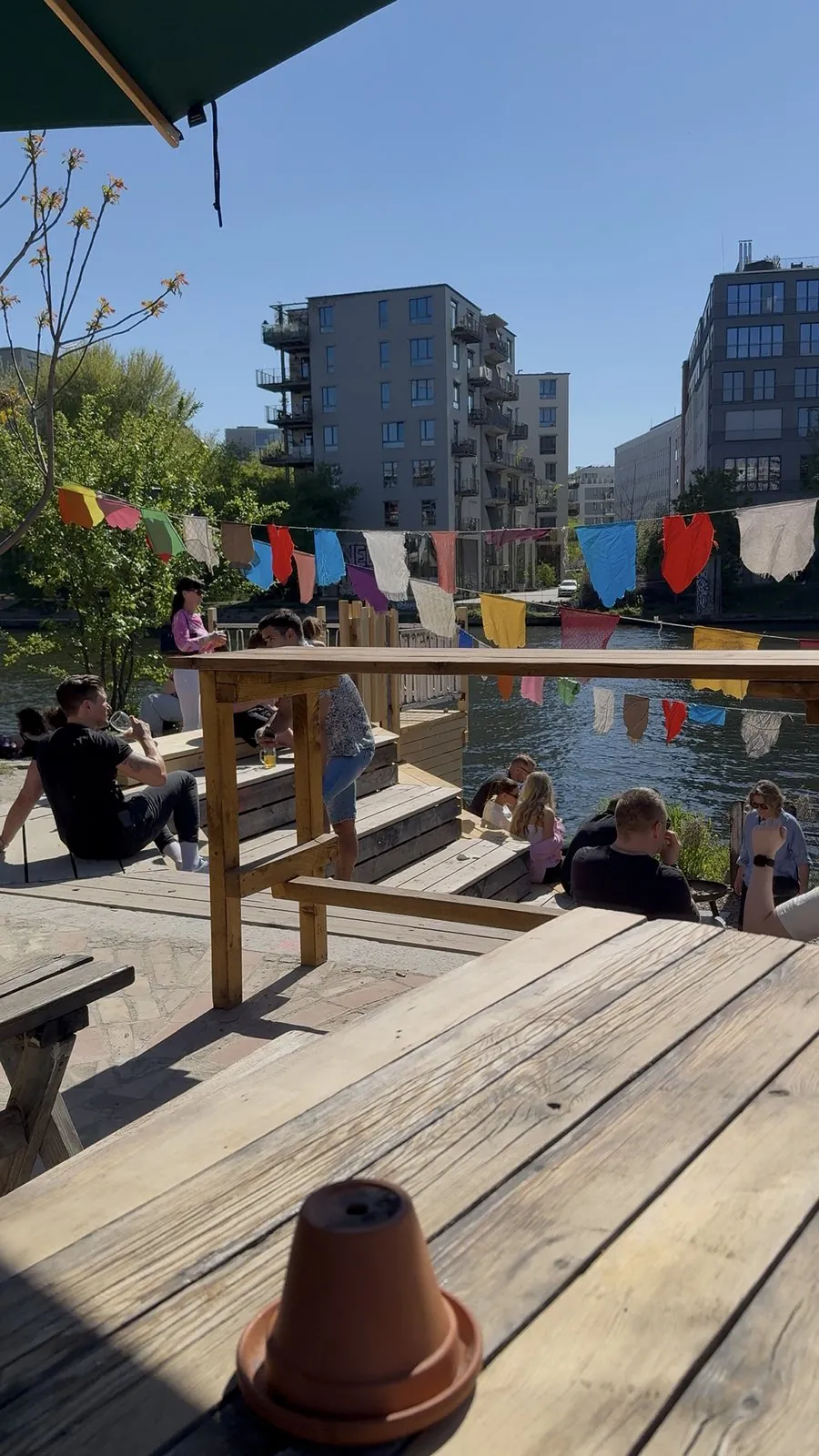
A word about the weather, because it shaped the whole week: it was, improbably, glorious — seven days of real sun. Which meant Berlin did the thing Berlin does the instant the sky cooperates. It went outside.
The Biergarten is not a tourist concept here; it is closer to a civic reflex. Some sit right on the water. The formula is unchanging and perfect — a beer, something simple to eat, a long shared table, and conversation with whoever happens to be on the bench beside you. Berliners pour into these places at the first honest ray of sun, and they stay.
You hear, now and then, that Germans are cold. In Berlin, that has never been my experience. This is a city that has drawn in people from across Europe and the rest of the world — a genuinely international place — and it makes friends quickly, at a Biergarten table, over nothing more elaborate than a shared bench and the same good weather. The supposed reserve melts in about the time it takes to order a second round.
What Berlin gives back
I was there for the first of May. May Day in Berlin is marked the way the city marks most things — outdoors and at volume. Across the city, parks fill with sound systems and DJs, and people dance.
What stayed with me was who was dancing. Techno, in our heads, belongs to the young — to a certain crowd, a certain hour of the night. In a Berlin park on the first of May it belongs to everyone. I watched families dance to it. I watched the full span of a city move to the same beat — children barely two years old, and people well into their eighties, and every age in between, all of it at once, in the same light, in the same park.
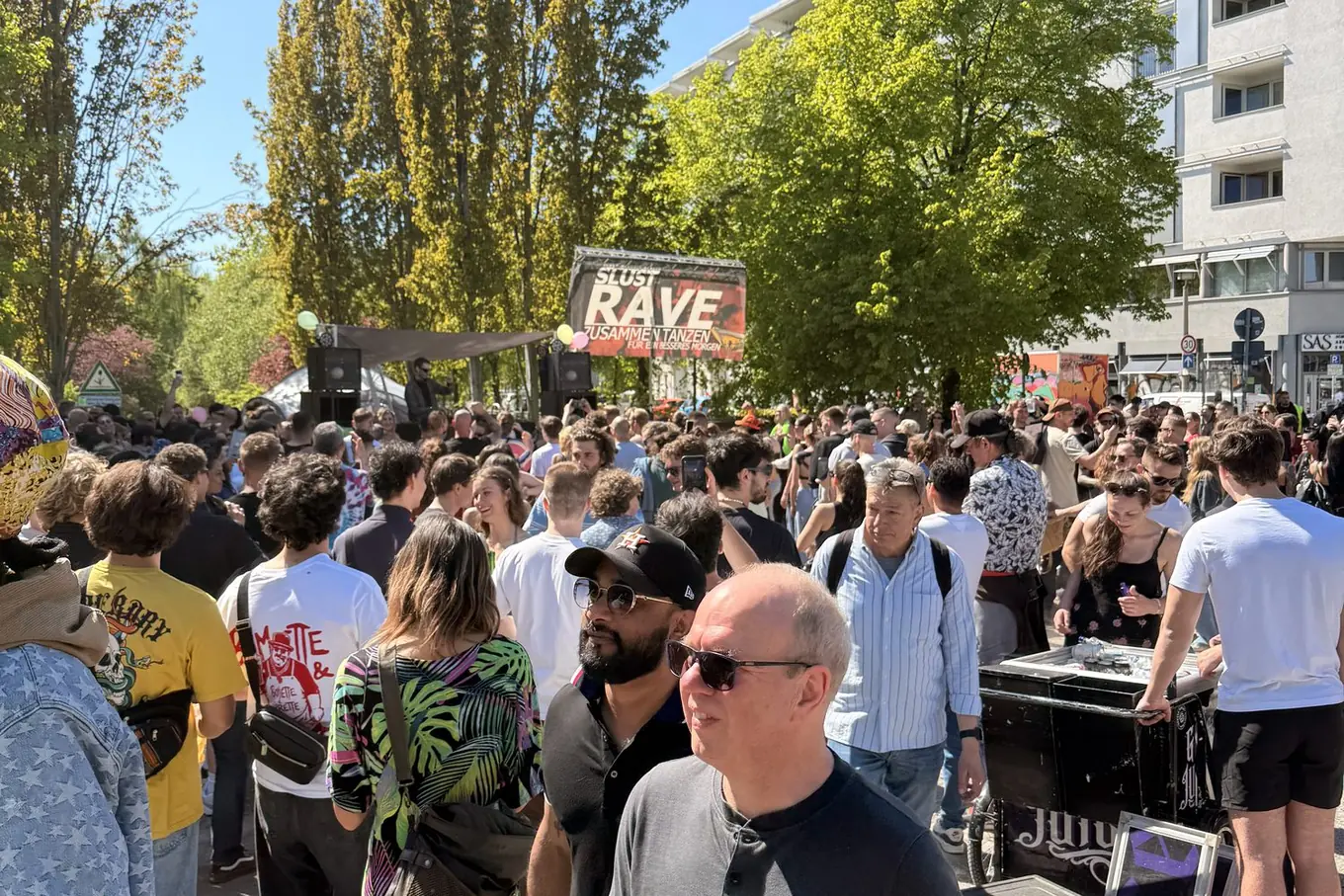
That image is, in the end, the whole article.
A city that keeps its railways as parks. That keeps the Frauen and Männer signs on the burger joint. That keeps the pink triangle on the station wall, and the hardest chapters of its own history on full display in a museum that has stood since 1985. A city that brings its entire story into the light — including the painful pages, including the queer ones — and then, having done that, is still able to be joyful. Eighty-year-olds dancing techno beside two-year-olds is not a contradiction of all that remembering. It is what the remembering makes possible.
That is why a place like this matters to a gay traveler, and why I wanted the first entry of this Journal to be about it. A city that refuses to erase its history is a city that, in a deep and unforced way, lets you feel seen — not an exception it is tolerating, but part of the story it has chosen to keep.
That is the whole of what I mean by travel as you are. It is not a slogan about going somewhere new. It is about going somewhere that has already made room for the entire truth of who you are — and discovering the room was there all along.
Berlin, every time I return, has changed again. It just never changes by forgetting.
If you would like to see it this way yourself, I have built a week around it: Berlin & Dresden.
About the author
Francesco Mevoli is the founder of Gay Up Travel, a boutique travel agency he started in 2021. Italian and based in Italy, he designs tailor-made trips for gay men who want to see the world as themselves — choosing every destination, hotel, and local partner personally. Gay Up Travel is a member of IGLTA. New entries in the GUT Journal are published every few weeks — the story travels from Berlin on to Dresden, in our GUT Special on Dresden, the city that put itself back together, and into the contemporary art hidden inside its royal palace. And if reading this has started a trip taking shape in your head, that is where my work begins: plan your trip with me.