
The Contemporary Art Hidden Inside Dresden’s Royal Palace
There is a particular kind of surprise I look for when I travel, and I rarely say so out loud because it sounds too neat. It’s the moment a place stops performing for you and simply tells you the truth. In Dresden, that moment didn’t happen where I expected it — not in the gold, not in the famous vaults — but in a quiet contemporary room inside the Residenzschloss, the old royal palace.
Most people come to the Residenzschloss for the treasures: the Grünes Gewölbe, the Turkish Chamber, the armory full of tournament horses. They’re right to. But woven through those historic rooms is a small, sharp exhibition called Kunstkammer Contemporary (now in its third edition), where the Staatliche Kunstsammlungen Dresden hang contemporary works among the baroque. This year the whole show turns on a single idea — abstraction — and not the cold kind. Not art that has abandoned the real world, but art caught in the act of stepping away from it, with the body and the self still visible underneath.
I walked through it slowly. Three works stopped me, and I keep returning to them in my mind. This is why I’d want you to see them.
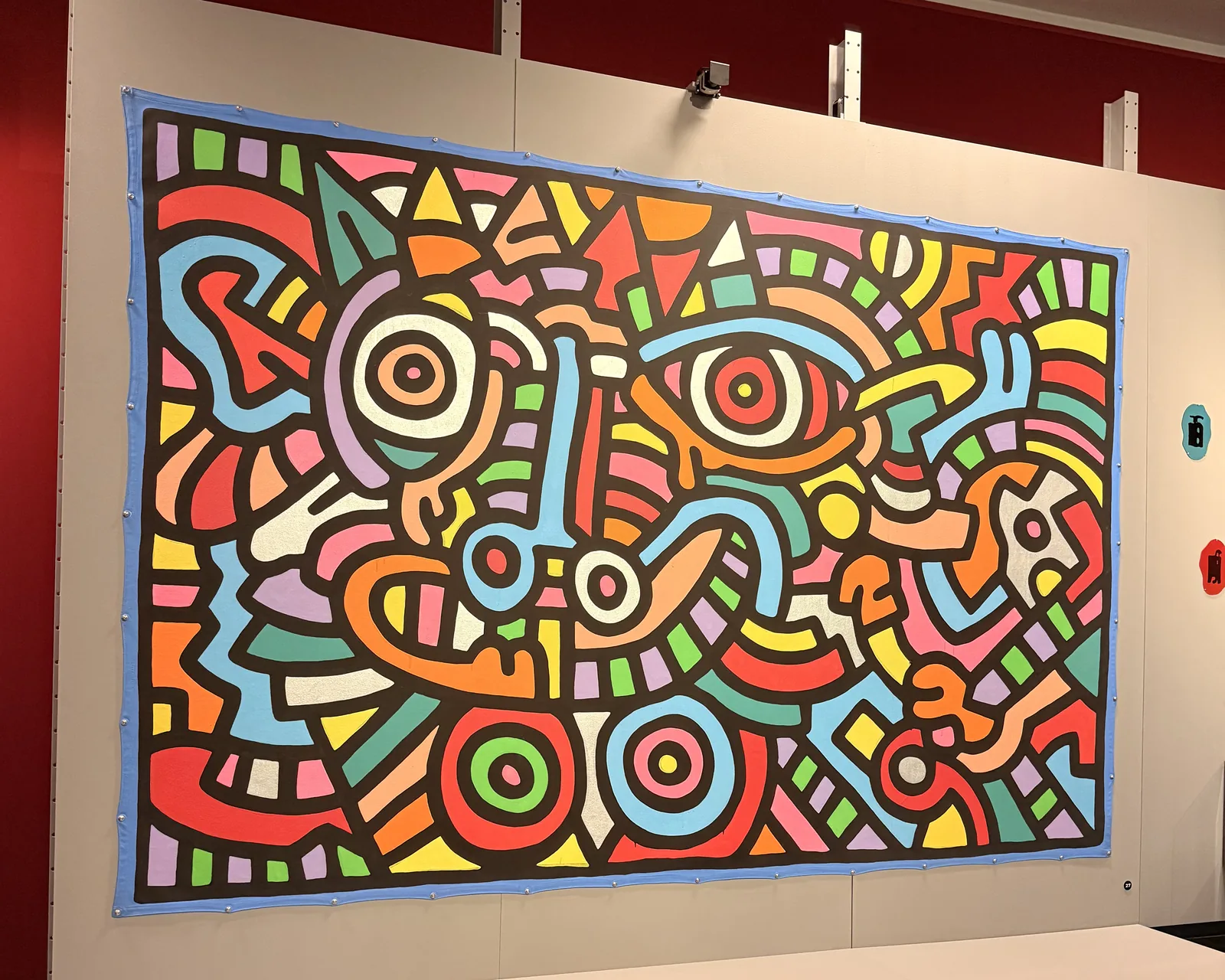
Keith Haring, Untitled (1986)
You don’t need a label to recognize a Keith Haring. The line is unmistakable — that urgent, looping energy he made famous on the walls and subways of New York, the figures that look like they’re dancing even when they’re warning you about something.
What moved me wasn’t the recognition, though. It was the address. Here was one of the great gay artists of the twentieth century — a man who turned public space into a language of joy and protest, who made work about love and the AIDS crisis with the same bright, generous line — hanging quietly in a Saxon royal palace built for absolute power. Haring spent his short life pulling art out of the museum and into the street, where everyone could meet it. To find him here, inside some of the most formal architecture Europe ever built, and completely at home in it, felt like a small act of justice. The work has no title. It doesn’t need one. For me it became the thread of the entire room: proof that the contemporary voice — playful, queer, alive — now sits at the center of the building, not at its edges.
Olaf Holzapfel, Ego Torso (GB) (2008)
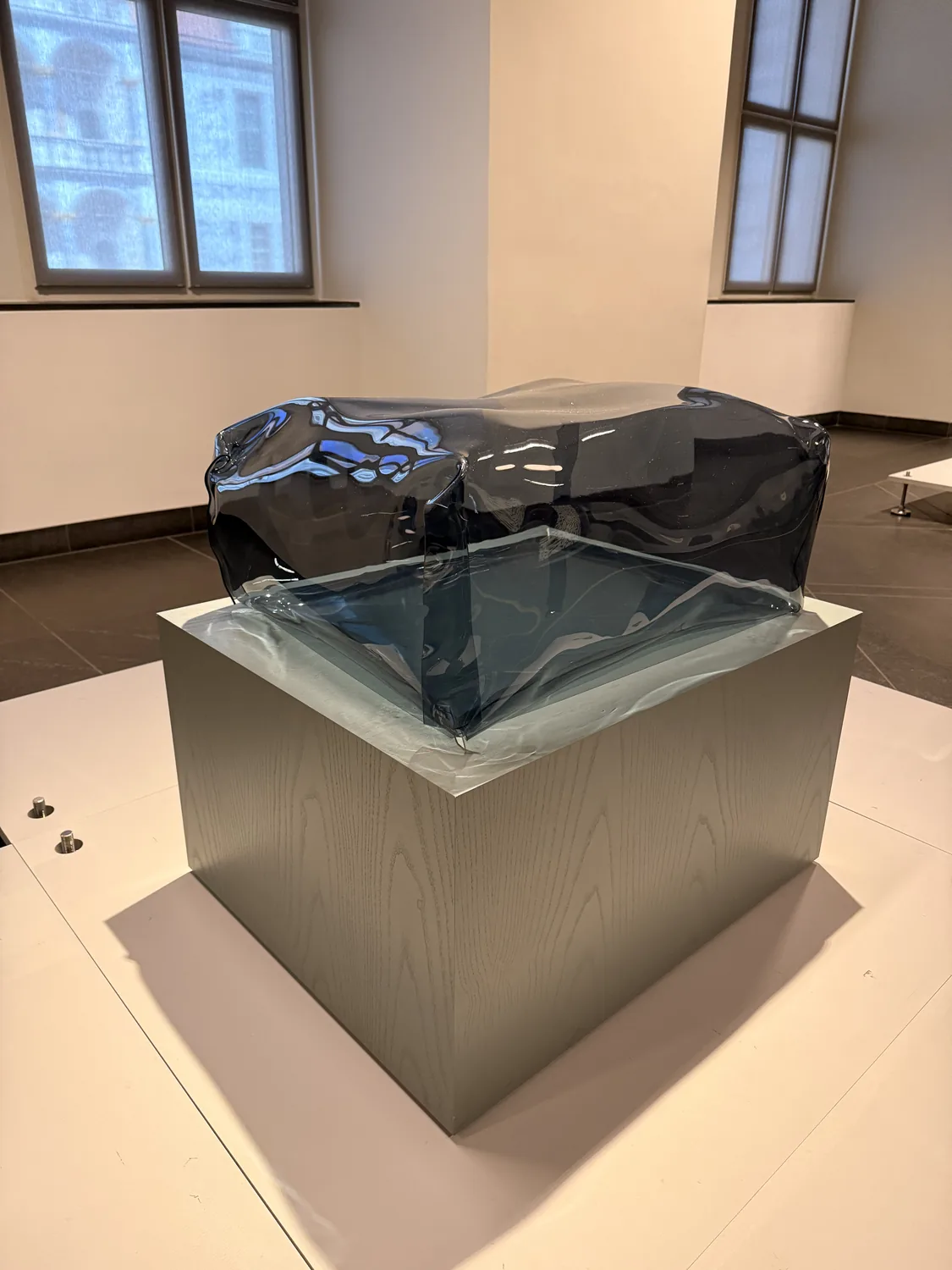
A little further on, a cube of bluish, transparent acrylic glass rests on a painted wooden base. The surface is so smooth it looks almost liquid — as if it might run off the plinth and pool on the floor. It doesn’t, of course. It holds. And the longer you look, the stranger that stillness becomes.
The title does the quiet work here. Ego Torso asks you to read this clear, empty form as a human body — a torso without head or limbs, the body reduced to its most essential shape. It places the piece inside a very old sculptural tradition — think of the broken classical torsos in every great museum — but Holzapfel has emptied it out and made it see-through. You’re not looking at a body so much as into one, and finding nothing there to hold onto.
That emptiness is the point. Because you can see straight through it, the work turns into a question rather than a statement: Can we ever really know another person to their core? Are we who we appear to be? Do the images we carry of each other always stay partial, maybe even false? I stood there longer than I expected to. It’s a work about the limits of how well we see each other — which, if you think about it, is the most human subject there is, and a quietly tender one to find in a room about abstraction.
Karen Packebusch, BOMBER (2020/21)

The piece I haven’t stopped thinking about is the simplest to describe and the hardest to forget. From across the room it reads as a white bomber jacket on the wall — that universal symbol of toughness, of armor, of not being touched. Up close, the fabric dissolves. The jacket is made entirely of painkillers — pills, carefully arranged into the shape of resilience.
Karen Packebusch built it out of her own experience of pain, and the result holds two truths at once. The bomber is a shell that protects, and a weight that exhausts. It’s the body trying to stay upright and capable while it’s quietly marked by something it carries. The work lives in the tension between what you recognize and what unsettles you: the jacket stays a jacket, familiar and almost casual, while the material it’s made of turns it fragile, even ornamental. A hard object becomes a soft confession. I found it almost unbearably honest — a garment of strength revealed to be a garment of vulnerability — which is a thing many of us understand and few of us say.
Why these three, together
I didn’t plan to write about a trio. But standing in that room, I realized the three works were having a conversation. Haring is the voice — public, queer, unafraid. Holzapfel is the body, made transparent until you can’t quite find the person inside it. Packebusch is the same body, holding itself together through pain it won’t show on the surface. Put them in a row and you get a small, complete meditation on how we present ourselves to the world and how little of it the world actually sees — staged, of all places, inside a palace whose entire purpose was display.
That contrast is what makes it land. Dresden spent centuries perfecting the art of the magnificent surface. And then, three rooms deep, it hands you three works about everything the surface hides.
Why I’d take you here
I work in beautiful hotels and long lunches and golden light, and I believe in all of it. But the reason I keep choosing Dresden for the kind of traveler I work with (and, yes, Dresden is gay friendly) is that the city refuses to be only a postcard. It will give you the baroque and the river and the porcelain — and then, without warning, it will hand you a Haring, a body made of glass, and a jacket made of medicine, and trust you to feel something real.
That’s the version of luxury I care about: not just being shown the famous things, but being taken to the moment underneath them. When I plan a day in Dresden, I don’t treat the Residenzschloss as a checklist of treasures. I build a slow morning around it — the historic vaults first, then this quiet contemporary room — so that the city’s two faces, the magnificent and the honest, land in the same breath.
If you want to see them
The three works are part of Kunstkammer Contemporary III (the German title is Kunstkammer Gegenwart III), drawn from the Schenkung Sammlung Hoffmann collection and shown inside the Residenzschloss in Dresden’s Altstadt. The current edition is built around the theme of abstraction and runs through early January 2027 (28 March 2026 – 3 January 2027). The palace is open daily 10:00–17:00, closed Tuesdays, and a single Residenzschloss ticket also gives you the historic rooms around it — the Grünes Gewölbe, the Türckische Cammer, the Rüstkammer — which is exactly why I’d give it a full, unhurried morning rather than a quick look.
(For the travelers I work with, I fold this into a Dresden itinerary that pairs the palace morning with the right neighborhood, the right table for lunch, and the slower, queerer layer of the city most visitors miss.)
FAQs
Where can I see Keith Haring’s work in Dresden?
A Keith Haring Untitled (1986) is on display as part of the Kunstkammer Contemporary III exhibition inside the Residenzschloss (Royal Palace) in Dresden, on show through early January 2027.
What is Kunstkammer Contemporary?
It’s an exhibition that places contemporary works from the collections of the Staatliche Kunstsammlungen Dresden among the historic rooms of the Residenzschloss. It’s re-hung roughly once a year around a single theme; the current (third) edition is built around abstraction.
When is the exhibition open and how do I visit?
The Residenzschloss is open daily 10:00–17:00 and closed on Tuesdays; the exhibition runs 28 March 2026 – 3 January 2027. A Residenzschloss ticket also includes the surrounding historic rooms, so it’s worth setting aside a full morning.
Is Dresden’s Residenzschloss worth it for contemporary art?
Yes — and partly because it’s unexpected. Alongside its famous baroque treasures, the palace currently shows sharp contemporary pieces (including a Keith Haring, Olaf Holzapfel’s Ego Torso, and Karen Packebusch’s BOMBER), which makes for a richer, more surprising visit than the treasures alone.
About the author
Francesco Mevoli is the founder of Gay Up Travel, a boutique travel agency he started in 2021. Italian and based in Puglia, he designs tailor-made trips for gay men who want to see the world as themselves — choosing every destination, hotel, and local partner personally. Gay Up Travel is a member of IGLTA. Dresden is two hours from Berlin, and the two belong on the same trip: I wrote about the first in What Berlin Holds, and about the second in our GUT Special on Dresden. And if reading this has started a trip taking shape in your head, that is where my work begins: plan your trip with me.