

GUT Special · Second Edition — September 2026
Malta for Gay Travelers
The Island You Didn’t Expect
Editor’s Note · Second Edition — September 2026
When I published the first edition of this Special, I made you a promise: I hadn’t stayed at La Falconeria yet, and the second edition — after the trip — would tell you about the rooms and the breakfast.
I’ve now spent four days on the island: two nights at La Falconeria, two at The Gomerino, walk-throughs of the two other Allelòn houses in Valletta, and all of it on foot with a notebook that filled faster than I expected.
This edition keeps everything the first one got right, and adds what only standing in a place can teach.
In this guide
- Why Malta
- Malta for travelers like us
- Valletta — how to enter it
- Where to stay
- Beyond Valletta
- Valletta on foot
- The GUT selection
- Practical information
- Four houses, one question
- Malta in a wider journey
A long read, on purpose. Jump to what you need, or tell me your dates and I’ll build Malta around you.
Why Malta
I built our Malta itineraries with Allelòn Hotels — a Maltese boutique collection that includes La Falconeria in Valletta — because Malta is one of the most quietly welcoming places in the Mediterranean for two men traveling together. The country ranks #1 on ILGA-Europe’s Rainbow Map for nine consecutive years (2016–2024) and still ranks among the top three in Europe. Same-sex civil unions have been legal since 2014, same-sex marriage since 2017, and conversion therapy has been banned since 2016. English is a co-official language. The archipelago sits at the center of the Mediterranean — short flights from most European capitals, mild climate year-round. The Malta we design for our clients is private, slow, and built around the small-island scale rather than the cruise-ship one.
There’s a precise moment when you realize Malta is not what you thought it would be.
It doesn’t happen at the airport, or in the taxi to Valletta. It happens later — after you’ve unpacked, after you’ve stepped out with no particular destination in mind — and you find yourself on a waterfront in Vittoriosa, with the Grand Harbour below you and Fort St. Angelo on the other side, motionless, as if time had decided to stop right there.
Nothing moves except the gulls and the ferries. The limestone walls — that honey-colored stone that builds everything on this island — catch the afternoon light and turn almost orange. It’s not a special effect. It’s the same light as always, except that Malta sits this far south, this close to Africa, and the sun arrives here with a different kind of force. As if it has traveled less.
On the waterfront in Vittoriosa, facing directly onto the harbor, there’s a bench painted in rainbow colors. No plaque, no tourist trail. Just a short inscription — a local saying, something about courage, or perhaps about the weight of small things. I never learned who placed it there, and perhaps that was part of the point. Those colors, in that silence, with the harbor in front of me and ancient stone all around, told me everything I needed to know about how this island treats people like me.
Malta doesn’t announce it. It shows you.

Malta for Travelers Like Us
There’s something I always do before bringing a client to a new destination: I stop reading the guides and start looking at how the country actually treats its gay citizens. Not the marketing campaigns, not the advocacy websites. The laws, the recent history, what happens in ordinary life.
Malta surprises you.
Not because it’s a progressive island in the Northern European sense — it isn’t, and it would be dishonest to say so. It’s a deeply Catholic country, with a Church that still carries weight in public life. But something interesting has happened here in recent years: Malta has chosen to be a place where LGBTQ+ people are protected by law, recognized by the state, and in daily life — at least in the cities and tourist centers — simply left to live.
If you want the short, practical version of this — what the law actually says, and what I tell clients before they go — it lives on its own page: is Malta gay friendly?
Same-sex marriage has been legal since 2017. Adoption too. Legal protection against discrimination exists and is enforced. Malta Pride takes place every year in September in Valletta — not as an act of resistance, but as an event the city hosts naturally, with the support of local institutions.
This doesn’t mean Malta is Amsterdam. Gay life is concentrated mainly in Valletta and around Paceville — the rest of the island is more rural, more traditional, and not the kind of place where you’d expect LGBTQ+ visibility. But it’s not a place where you need to watch your back either. That distinction matters.
For the kind of traveler GUT works with — a gay man who wants to move freely, stay well, eat well, travel without anxiety — Malta works. It works because the question of safety is settled, and that frees up all your attention for what the island actually has to offer.
Which is, as we’ll see, quite a lot.
Valletta — How to Enter It
Arriving in Valletta has a theatrical quality you don’t forget.
You reach City Gate — the stone arch that separates the rest of the island from the walled city — and you step through. This is not a metaphor. It’s a literal crossing: on one side, noise, traffic, the ordinary rhythm of any Mediterranean city; on the other, the relative quiet of a capital built in a single moment, in the sixteenth century, by the Knights of Malta, according to an urban plan that has never really been undone.
The streets are narrow and uphill. The buildings are tall, in that honey-colored limestone that by this hour — whenever you arrive, aim for late afternoon — is already turning amber. And the balconies.
The balconies of Valletta deserve a pause.
They’re enclosed on three sides, each painted a different color — bottle green, brick red, midnight blue, mustard yellow — and they jut out over the street like small secret rooms suspended between the public and the private. They’re not decorative: they’re how Maltese families have historically lived the outdoors without fully exposing themselves. A presence in the world that reserves the right to withdraw. There’s something in this I find deeply familiar, even if I can’t quite explain it with words.
Valletta in the evening, after the day-trippers have gone back to their seaside resorts, becomes an almost intimate place. Restaurants fill slowly. Squares come alive with locals. The noise changes register — less frantic, more rooted. That’s when it’s worth walking without a destination, turning a corner at random, stopping at a bar that doesn’t have its sign translated into English.
That is why you stay in Valletta, and not somewhere else.

Where to Stay — Allelòn’s Four Houses in Valletta
When choosing a hotel for a GUT client, the question is never “how many stars does it have.” The question is: does this place understand who we are?
La Falconeria answers that in the most direct way possible. It’s the first hotel in Malta to become an Official Hotel Partner of Malta Pride — not as a sponsor of a marketing campaign, but as a position taken. That kind of choice, made early, says something about how a property thinks about its guests.
The hotel is in Valletta, on Melita Street, a few steps from St. John’s Co-Cathedral and less than ten minutes’ walk from anything worth seeing. But the location is almost secondary to what you find inside.
The building carries two centuries of history and a World War II bomb in its past. The front half is original — marble floors, high ceilings, the kind of architecture that reminds you where you are every time you come downstairs. The back half was destroyed during the wartime bombings and rebuilt in a modern style, but with a formal coherence with the rest that you rarely see in renovations. In between, an open courtyard — one of those quiet pauses that old cities still know how to offer.
Forty-three rooms. Some with balconies and harbor views. An in-house restaurant, L’artiglio, with Mediterranean cuisine. A small indoor pool.
It’s not a large hotel. It’s not designed to be.
It’s designed for those who want to be inside Valletta, not near Valletta. For those who want to open the front door in the morning and already be in the city — in its light, its contained noise, its smell of stone and coffee — without needing a taxi or crossing a parking lot.


What’s true in all four houses
Allelòn have four addresses in Valletta, and I want to deal with what they share before I separate them — otherwise I’d be telling you the same thing four times.
Breakfast, since I promised it. It happens in a dedicated room on the ground floor, where the bar is. There’s a buffet, but it’s deliberately small — because across all four houses the real breakfast is à la carte, cooked to order. I’ll declare my bias here: eggs Benedict are my weakness, and theirs are properly made, which if you’ve ordered them in enough hotels you know is rarer than it should be.
It sounds like a small operational choice. It changes the shape of the morning. A buffet asks you to serve yourself and move on; a kitchen that cooks your breakfast asks you to sit down.
The welcome, which is the part I actually screen for. Every property has a welcome on paper. What matters is whether it holds when nobody is performing.
It held from the front desk outward — reception, the breakfast room, the bar, the bar by the pool. Courteous is the easy word for it; available is the accurate one. And the moment that told me the most was the least dramatic: mid-afternoon, someone came by to ask whether we wanted the room refreshed, and whether we needed water.
That second question has a bottle behind it. There’s a refillable bottle in the room, and points around the houses to fill it. A small piece of engineering against a large amount of plastic — and the kind of thing that only exists when someone in the building is actually responsible for it.
Someone is. Daniel Buhagiar is Allelòn’s Guest Relations and Sustainability Manager — a title that in most hotels means a paragraph on a website, and here means a bottle in your hand. He has also just qualified as a licensed guide, and he knows Valletta the way people know a city they didn’t have to learn: the corners you’d walk past without looking twice, and the centuries of story sitting underneath them.
This is what I mean when I say the building isn’t the point. The building is beautiful. The welcome is the product. And the only way to find out whether a welcome is real is to turn up and be welcomed.
Now the differences.

La Falconeria — the contemporary one
The first edition of this Special ended this section with an honest admission: I hadn’t slept there yet. Now I have.
The room was spacious, and comfortable in the way that only shows up in the details — an espresso machine you actually reach for in the morning, and lighting that has clearly been thought about rather than simply installed: warm where you read, low where you don’t need it. Small things. They’re also the things you notice at seven in the morning and at eleven at night, which is most of the time you actually spend in a room.
But the room’s real argument is outside it. A private terrace, with loungers and low tables, over the historic centre of Valletta — the dome of Knisja Santu Wistin on one side, the sea on the other. I shot up there in the late morning and again in the evening, and it’s the evening that makes the case: the limestone turns the colour the whole island is known for, and you’re above it, with a coffee, doing nothing in particular.
That terrace is the answer to the question I ask of every hotel before it reaches a client’s itinerary: what does this place give you that the one down the street doesn’t? Here it’s a private piece of the skyline, which in a capital this dense is not a small thing.
The other detail I keep coming back to is smaller and more Maltese: leaning out of a traditional enclosed balcony with a coffee in hand, the city moving below. It’s the most ordinary gesture on the island, and the first one that made me feel like I was living in Valletta rather than visiting it.
The house reads contemporary throughout — velvet, ribbed wood panelling in the atrium, industrial-style bathrooms, and the traditional Maltese cement tiles reworked in a modern key.
Downstairs, the cave. The first edition called it “a small indoor pool” and moved on. That undersold it considerably.
The pool is on the lower floor, and it is carved out of a cave in the rock — the same soft limestone Valletta is built from, except here it’s over your head instead of under your feet. I went down to it after a long day walking the city, which turns out to be exactly what it’s for: cool, quiet, and completely separate from the street you just left.
This is the amenity I would have undersold forever if I hadn’t stayed. A pool is a line on a fact sheet. A cave under a two-hundred-year-old building, at the end of a day on your feet, is a reason to come back to the hotel before dinner instead of after — and on a Malta itinerary in summer, that hour matters more than people expect when they plan. There’s a small gym down there as well, for anyone who keeps the routine on the road.
One honest note. L’artiglio, the restaurant downstairs, I didn’t have dinner at — so I’m not going to review it. But it isn’t unknown to me either: it’s the same kitchen that cooked those breakfasts, two mornings running. That’s not a verdict. It’s more than you usually have when you sit down somewhere new. And what a restaurant in the building is really for is the evening you’ve been on your feet since morning and the last thing you want is to choose one.


The Gomerino — the classical one
Halfway through the trip I moved a few streets over, to The Gomerino on St Paul’s Street. Same family, different century.
If La Falconeria is the contemporary one, The Gomerino is the classical one. Marble floors, boiserie on the walls, floral motifs on the cushions, and a series of prints of old Maltese trades, captioned in Italian.
That last detail is worth a pause, because it isn’t decoration. Italian was the language of law and learning in Malta for four centuries, from the arrival of the Knights onward, and it remained an official language of the islands until the 1930s — well into British rule. Those prints aren’t a flourish for visitors. They’re the building remembering what it used to speak.
The room follows the same register — generous in size, classical in its detailing, with a balcony on the façade. Between the two houses that difference is the honest summary of the choice: at La Falconeria my outdoor space looked out over the city; here it looks onto the street, and the city comes up to meet you.
The roof is the argument. Everything above is character. The reason to book The Gomerino is upstairs.
The rooftop pool looks straight out over the Grand Harbour — the Three Cities on the far shore, and Fort St Angelo holding the centre of the view at a scale photographs keep failing to carry. This is the Grand Harbour people have in mind when they say Malta was built around its water — the fortifications, the Three Cities, the whole sweep of it — except you’re getting it from a deck chair with a drink in your hand.
I’ll say it the way I’d say it to a client: I would stay here for the terrace alone. Even just for a cocktail at the end of the day, before going anywhere else.


Palais Le Brun — the grand one
Palais Le Brun is the most classical of the four, and it makes no apology for it.
The rooms are where it spends its argument: large, with crystal chandeliers, deep boiserie behind the headboards and serious Persian rugs underfoot. One side of the building looks down Old Bakery Street; the other looks out to sea. One room has a jacuzzi facing the water — the kind of detail I file away for a specific sort of anniversary.
The roof keeps the register rather than breaking it: a pool with a sea view, white wrought-iron tables and chairs. Where The Gomerino’s terrace is about the harbour and its history, this one is about sitting still somewhere that has decided exactly what it is.


San Karlu — the quiet one
San Karlu is where the group’s design thinking lands closest to now. The rooms read as a modern hotel with an eye on the classical: tall headboards matched to the runner, soft colours on the walls, marble bathrooms. Elegant without insisting on it.
But its real argument is out of the window. San Karlu looks over the gardens of the Valletta Design Cluster — and that needs explaining, because it isn’t a park.
The Cluster occupies Il-Biċċerija l-Antika, Valletta’s old abattoir, a seventeenth-century building that had been barracks, cotton spinnery and bakery before it was emptied in the 1980s for a demolition that never came. By the 2010s its roof had largely fallen in. It reopened in 2021 — a legacy project of Valletta’s year as European Capital of Culture — as a centre for design and creative practice: studios, a makerspace, a teaching kitchen, and on top of all of it a public roof garden of indigenous plants and water, which took Malta’s award for public open space the year it opened.
So the green you’re looking at from that window is one of the newest civic ideas in the city, sitting on one of its oldest buildings. That is a very Valletta arrangement, and on its own a good reason to ask for the side that faces it.


Malta, planned around you
Four houses in Valletta, the coast, Gozo and Comino — in the order that fits your dates and your pace. Tell me what you have in mind and within 48 hours you get two or three curated directions.
Beyond Valletta — What’s Worth the Trip
Malta is small. That’s one of the things that makes it so well-suited to travelers who want to see a lot without wasting energy on logistics. From the hotel, almost everything is reachable in under half an hour. That doesn’t mean everything is equal — some things deserve half a day, others an hour, and some are better skipped entirely.
Here’s the GUT filter.
The Grand Harbour — by ferry
The view of the Grand Harbour from Valletta or Vittoriosa is already something. But the perspective that changes everything is from the water.
The ferries connecting Valletta to the Three Cities — Vittoriosa, Senglea, Cospicua — cross the harbor in a few minutes. This is not a tourist excursion. It’s how locals move, and that’s exactly why it’s worth doing. You stand on deck, watch the walls rise on both sides, and understand the real scale of what you’re looking at. The Grand Harbour is not a backdrop. It’s an architecture.
Mdina — Twenty Minutes and Five Centuries
Eleven kilometers from Valletta, there’s a city you can walk in fifteen minutes.
Mdina is tiny — a few hundred inhabitants, enclosed within its limestone walls — and this makes it feel almost unreal. The streets are too narrow for cars. The silence, in the early afternoon after the tour buses have left, is dense. The cathedral is baroque and imposing. Alleys lead to alleys that lead to terraces with views across the Maltese plain all the way to the sea.
You don’t spend a day here. You spend an afternoon, slowly, and come back with something difficult to describe — that feeling of having seen a place that still exists for itself, not for whoever arrives from outside.
Marsaxlokk — The Fish Market
In the southeast of the island, away from the main circuits, there’s a fishing village that mass tourism hasn’t entirely transformed yet.
Marsaxlokk. The harbor is full of luzzu — the traditional Maltese boats painted in primary colors, with the Eye of Osiris on the bow, a Phoenician legacy no one ever stopped using. The fish market takes place on Sunday mornings, early. Tuna, lampuki, freshly caught octopus, vendors calling out prices. If you have any interest in food — and GUT clients usually do — this is one of those places that stays with you.

Pastizzi — The Most Honest Thing You Can Eat in Malta
They’re not in a restaurant. They don’t have a tasting menu. They cost less than a dollar.
Pastizzi are Maltese street food — flaky pastry filled with ricotta or peas, sold warm in bars and village bakeries from six in the morning. Eat them standing at the counter, with coffee. It’s one of those moments when you understand how a city actually eats — not how it presents itself to outsiders.
Gozo — If You Have the Time
The second island deserves a visit, but it requires a commitment: the ferry from Cirkewwa is an hour each way, and to see Gozo properly you need at least a full day.
The Citadel in Victoria, at the top of the hill that dominates the island, is worth the journey on its own. The walls are well preserved, the view is 360 degrees, and inside there are more churches than residents. Gozo is greener, slower, less cosmopolitan than Malta — at moments it feels like a different country entirely.
If your itinerary has a free day and you’re willing to slow down even further, go. If you only have three or four days on Malta, keep it as an option and decide on the ground.
Comino — The Crossing
The Blue Lagoon is exactly as it looks in photographs: crystal clear, turquoise, flawless. In summer it’s crowded. Make peace with that.
The reason to go isn’t the lagoon — it’s the boat crossing itself. Standing on deck, watching the Mediterranean shift color with the depth of the seabed beneath you. Some experiences don’t need a destination.

Paceville — One Honest Note
Near St. Julian’s, about ten minutes by taxi from Valletta, is where Malta’s nightlife concentrates. Gay-friendly bars, clubs, music until late. The crowd skews young. It’s not where a GUT trip is built — but if you want a carefree, fizzy night out — a few drinks, a bit of dancing — you know where to go.
Valletta on Foot: How I’d Give You the City
Four days, no car, everything walked. Valletta is that kind of capital — small enough to cross in twenty minutes, dense enough that you keep not crossing it.
St John’s Co-Cathedral, and the mistake nearly everyone makes
Yes, the Beheading of Saint John the Baptist is here: the largest canvas Caravaggio ever painted, and it earns every word written about it — more so once you know what he was running from when he painted it.
But the two things I’d tell you not to miss are both upstairs, and most visitors never climb. There is a second Caravaggio on the upper floor — Saint Jerome Writing — and to my eye it is the better painting. And there is a short documentary up there on his life and his Maltese years, which explains the Beheading properly.
Watch the film first. Then go down and stand in front of the painting. That is the whole tip, and it costs you fifteen minutes. Most people do it in the other order, or not at all, and end up seeing a famous canvas instead of the thing it actually is.
Then eat standing up
Pastizzi at a counter, mid-morning, hot out of the tray. Malta’s national snack is not a restaurant experience and there is no reason to turn it into one.

Give the Archaeology Museum an hour, and find the smallest thing in it
The National Museum of Archaeology is on Republic Street, inside the Auberge de Provence — the Knights’ own building, which is already a nice piece of irony given that most of what it holds is thousands of years older than the Knights. The collection runs from the Neolithic, from around 5900 BC, to the early Phoenician period.
If you like this sort of thing you will lose an hour happily. But I want to point you at one object, because I nearly walked past it and I have thought about it since.
It is called the Embracing Couple. It came out of the Ħal Tarxien temples, it is made of clay, it dates to roughly 3200 BC, and it is just over two centimetres tall — small enough to sit on a fingertip. It shows the upper halves of two human figures with their arms around each other. The modelling is rough enough that you cannot tell whether they are embracing or kissing, and it does not tell you who they are.
The museum’s senior curator has called it the only object from Maltese prehistory that captures a human feeling. Five thousand years, on this island, and the one surviving piece of emotion anybody made is two people holding on to each other. Go and find it. It is very small and very easy to miss.

A coffee with a ceiling worth looking up at
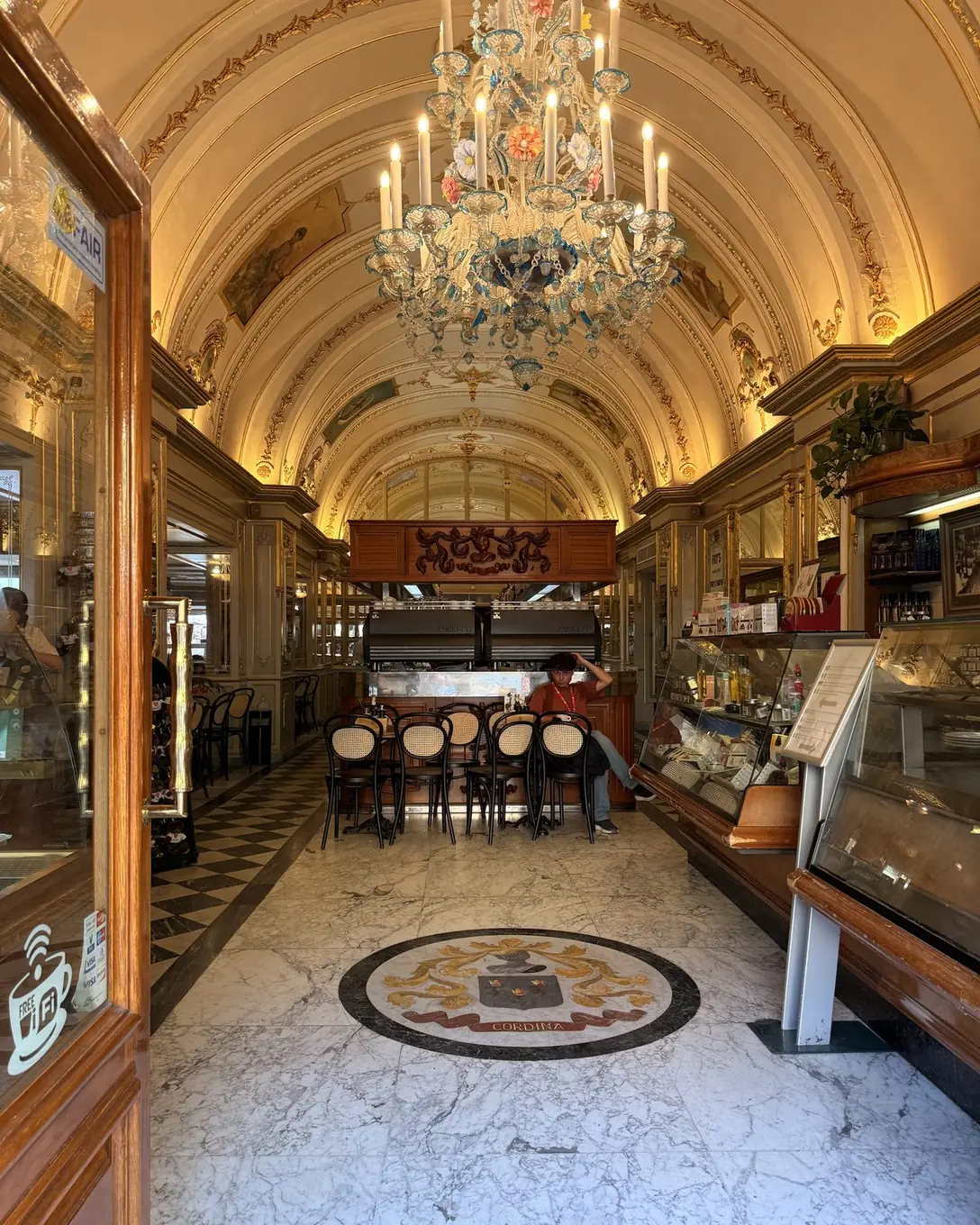
On Republic Square, Caffè Cordina is the old Italian-style café everyone ends up at, and for once the crowd is right. The Cordina family have been selling sweets in Malta since 1837 — the ancestors came from San Gimignano and started with nougat off a donkey cart — though the café itself dates to 1944.
Two things to notice while your coffee arrives. The building was the Treasury of the Order of St John. And the vaulted ceiling was painted by Giuseppe Calì, one of Malta’s great painters, with allegories of the powers that ruled the island — plus three later panels the family commissioned for Independence, the Republic, and joining the European Union. It is, in other words, a history of Malta on a ceiling, above the pastries.
Golden hour: Hastings Gardens
Late afternoon, walk up to Hastings Gardens, on the bastions above the entrance to the city. The view runs out over the water on one side and down over the square at the gate on the other, and it’s a genuinely beautiful place to watch the day cool off.
When I went, just before sunset, there were two yoga classes running on the grass. I mention it because it tells you something no photograph of the view would: this isn’t a monument you visit. It’s a garden people use.
Cross the water — this is the part I’d insist on
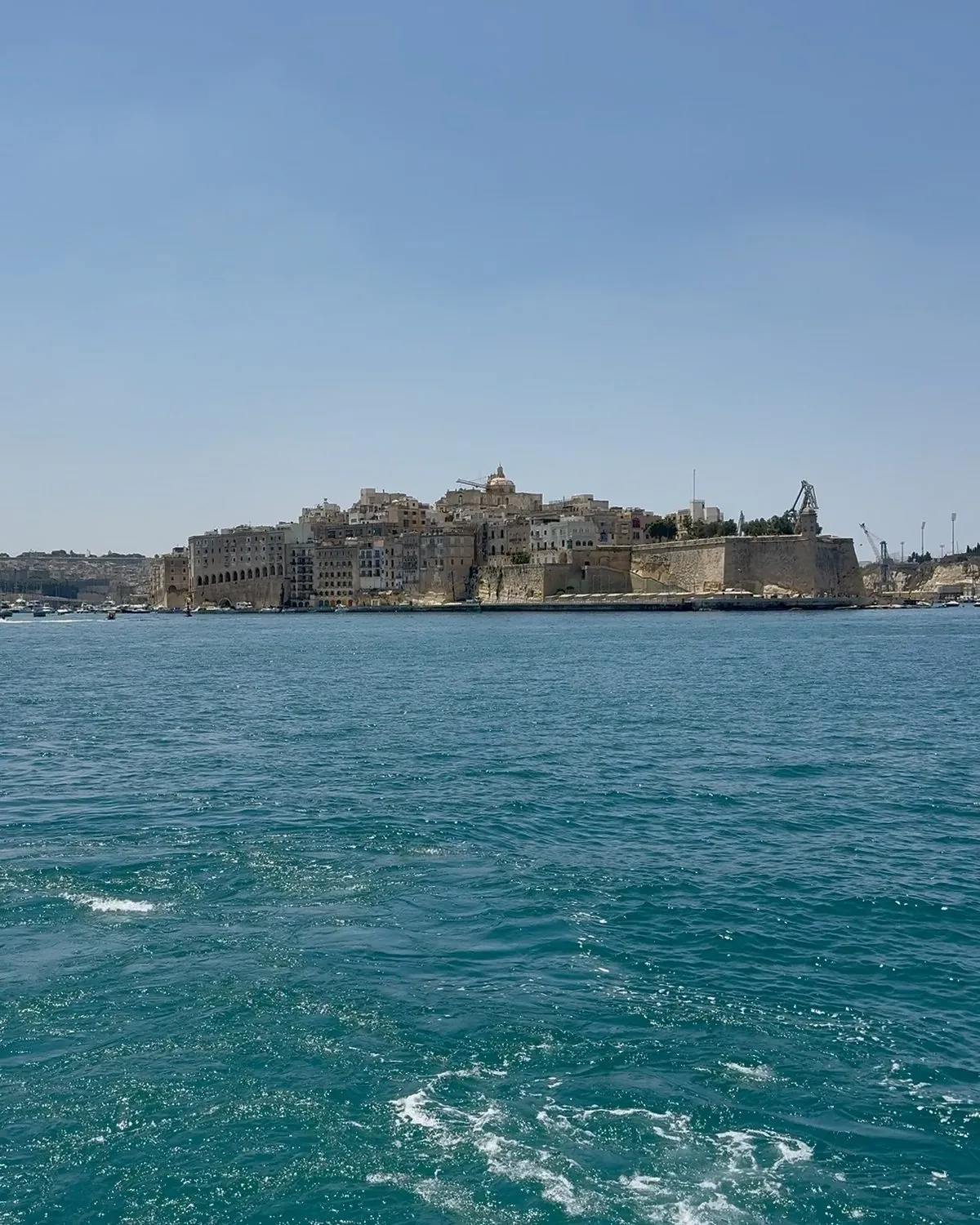
The traditional harbour boats below the Barrakka carry you over to the Three Cities in a few minutes, for a few euros, and it remains the best way to understand the scale of what you are looking at.
The Three Cities and the Grand Harbour are my favourite place in Malta. Not my favourite thing to photograph — my favourite place. Most visitors stay on the Valletta side, look across, and leave. The crossing is short, it costs almost nothing, and the city you land in is quieter, older and still lived in.


One evening, go where you weren’t planning to
Daniel took us to the Società Filarmonica Nazionale La Valette, the city’s band club, founded in 1874. If you don’t know what a Maltese band club is: it is the social engine of every town on these islands — a philharmonic society with a hall, a bar, and a century and a half of the neighbourhood’s evenings inside it.
We drank a Cisk, the local beer, in a room that has not been redecorated for anybody’s benefit, among a clientele that was entirely Maltese, and it felt like stepping back several decades.
You will not find this by searching for things to do in Valletta. That is rather the point of it — this is the kind of place you get taken to, not the kind you find.
And what I would cut
The noon cannon at the Upper Barrakka is a genuine spectacle and it is also extremely crowded. I stood through it. If your days are short, I would give that hour to the water instead.
The GUT Selection
Do
Take the Grand Harbour ferry at least once, in the late afternoon when the light is right. Get lost on foot in Valletta after eight in the evening. Go to Mdina on a Tuesday, not the weekend.
Eat
Pastizzi in the morning, at a local bar, not somewhere with a sign in English. Fish at Marsaxlokk if your itinerary includes a Sunday morning. Dinner at L’artiglio at La Falconeria for something curated without having to leave the hotel.
Avoid
Seafront resorts if you want to understand Malta. Organized coach tours. Gozo on a Saturday in high season.
Pack
Comfortable shoes with a firm sole. Valletta’s streets are stone and uphill. A light jacket for the evenings, even in summer — the Mediterranean wind at night is real.
Ready to see it for yourself?
Every place on this page is one I have walked, eaten in or slept in. Within 48 hours of your note you get a first itinerary — and the conversation is free.
Practical Information
When to go — Spring (April–June) and autumn (September–October) are the best seasons. The weather is mild, the cities aren’t overcrowded, and Malta Pride takes place in September — if you want to be there for it, plan ahead. Summer is hot and busy. Winter is quiet and windy, with occasional rain, but prices drop and Valletta is almost entirely yours.
How long — Three nights in Valletta is the minimum to genuinely feel the city. Four or five nights let you add Gozo, Mdina, and a half-day in Marsaxlokk without rushing.
Getting around — Malta has a public bus network covering the whole island. For those who prefer more flexibility, taxis and ride-sharing apps work very well — widely available, reliable, and easy to use. Renting a car is possible but unnecessary — and in Valletta it’s pointless, since the old city streets are built for people, not vehicles.
Language — Maltese is the official language, but English is spoken everywhere, by everyone, without exception. Malta was a British colony until 1964 and English stayed. You will never have the problem of not being understood.
The gay picture — Valletta and St. Julian’s are the centers of LGBTQ+ life. The rest of the island is more traditional. As a general rule: in the cities, you move freely. In rural areas, as in any Mediterranean country, a degree of discretion is sensible — not out of fear, but out of an awareness of context.
Four houses, one question
All four are in Valletta, all four are Allelòn, and the breakfast is the same in every one of them. So the choice isn’t about which is better. It’s about what you want your days to feel like.
Here is how I’d sort them.
La Falconeria — if you want contemporary. The modern one: velvet, ribbed wood, industrial bathrooms, Maltese tiles reworked for now. Also the one with the cave downstairs and, if you get the right room, a terrace over the rooftops.
The Gomerino — if you want the terrace. Book it for the roof: the pool, the Grand Harbour, the Three Cities and Fort St Angelo laid out in front of you. If you’re the kind of traveller whose best hour of the day is a drink somewhere high up, this is your address.
Palais Le Brun — if you love the classical. The grandest of the four: crystal, boiserie, Persian rugs, large rooms, a sea-facing roof in white wrought iron. One room has a jacuzzi looking at the water.
San Karlu — if you want intimate. The quiet one, modern and elegant with a classical eye, looking out over the gardens of the Valletta Design Cluster. The choice for a stay that wants to feel like a private address rather than a hotel.
How Malta Fits Into a Wider Journey
Malta works beautifully as a standalone trip — three to five nights, Valletta as your base, everything else a half-day away. But it also sits naturally at the beginning or end of a broader Mediterranean journey.
Sicily is less than 100 kilometers to the north. There are ferry connections from Pozzallo and Catania, and direct flights link Malta to most major European hubs and several North American gateways. If you’re already considering southern Italy — the Baroque towns of the Val di Noto, the food markets of Palermo, the quiet of the Aeolian Islands — Malta slots in with a logic that feels almost geographical rather than planned. That’s the kind of combined itinerary I design often for GUT clients.
Malta is not a bucket-list destination.
It’s not one of those places you visit in order to say you’ve been. It doesn’t have a single monument famous enough to justify the journey on its own, nor a beach spectacular enough to make it a classic beach destination.
What it has is something rarer: the ability to make you feel that time there moves differently. Slower, denser, more real. It’s the ancient stone, it’s the light, it’s the human scale of everything — a capital city you can walk across in twenty minutes, an entire island you can drive around in a day.
And for those who travel the way we do — with the constant awareness that we need to evaluate a place not just for what it offers, but for how it treats people like us — Malta has something more. It doesn’t ask you to adapt. It lets you be exactly who you are, and then shows you how beautiful it is.
That’s rare.
— Francesco

Gay Up Travel
GUT Special Malta — First Edition, April 2026 · Second Edition, September 2026, after four nights in Valletta with Allelòn Hotels.
A note on how this was made: Allelòn hosted our four nights in Valletta. No fee was paid in either direction, and no one saw this text before you did. The houses are named because they earned it — the same reason the first edition named La Falconeria before I had ever slept there.
Let’s plan your Malta
Tell me your dates, who you’re traveling with, and what matters most. Within 48 hours you get two or three curated directions — hotels, experiences and routes built around how you actually travel.