
A Small Flower for Lili Elbe

It was a little before four on a clear afternoon in early May when we reached the Trinitatisfriedhof, a cemetery in Dresden’s Johannstadt district, east of the old town. We had been out with a private guide, walking through the city’s queer history, and this is the place where that history narrows down to one person.
The first thing I noticed was the care. The cemetery is beautifully kept, green with spring, and her grave asks for no attention: a plain grey stone, a low bed of shrubs in front of it, and along the top a row of pebbles and a tiny figurine left by the people who came before me.
I left a small flower there. It is a very small gesture, and it is the reason I am writing this.
A name, two countries, no dates
The stone gives her name and two short lines in German that translate as born in Denmark, died in Dresden. No dates, nothing else. For a long time there was not even that. The first headstone was taken away at some point in the fifties or sixties, and for decades the grave stood unmarked.
Today’s stone dates from April 2016. Focus Features, the studio behind The Danish Girl, covered the cost, and the Danish ambassador attended the unveiling, together with David Ebershoff, whose novel the film was drawn from. There is something fitting in that. A film gave millions of people her name, and then helped carve it back into stone where she lies.
In my Dresden Special I wrote about Lili from the city’s side, as someone Dresden chose to keep. Standing at the grave, though, I found that I was thinking less about Dresden and much more about her.
Why the stone says Dresden
Her story starts in Copenhagen, with a marriage of two painters. She and Gerda Wegener were both students at the Academy of Fine Arts in Copenhagen when they met, and they married in 1904.
The name arrived almost by chance. The actress Anna Larssen was late for a sitting with Gerda, so Gerda’s spouse stood in, in stockings and heels; when Larssen finally appeared, she called the figure Lili. In Lili’s own account, she had been sharing one body with a male self, and eventually that shared life was no longer one she could live.
Doctor after doctor turned her away. The change came in Paris, in the summer of 1929, with Kurt Warnekros, a gynecologist from Dresden who listened. It was Warnekros who pointed her toward Berlin: in early 1930 she was assessed at Magnus Hirschfeld’s Institute for Sexual Science, and the first operation followed in March. Everything after that happened in Dresden, at the municipal women’s clinic by the river, with Warnekros operating. She is one of the earliest people on record to receive gender-affirming surgery, and nothing about it was routine.
That is why she took the river’s name, Elbe, and why she spoke of Dresden as the place she was born. In October 1930 her marriage was annulled, and she received a passport as Lili Ilse Elvenes. A French art dealer, Claude Lejeune, asked her to marry him. In June 1931 she returned for one more operation. In September she died in Dresden, of complications.
Parts of the story are still argued over, and I would rather say so. Her surgeons were convinced she had rudimentary ovaries from birth; historians do not accept that, and there is no file left to settle it, since the clinical records were lost in the 1945 air raids on the city. The film, for all its tenderness, takes liberties throughout. The nearest thing we have to her own voice is her memoir, Man into Woman, published in 1933, two years after her death.
What I took away from that afternoon
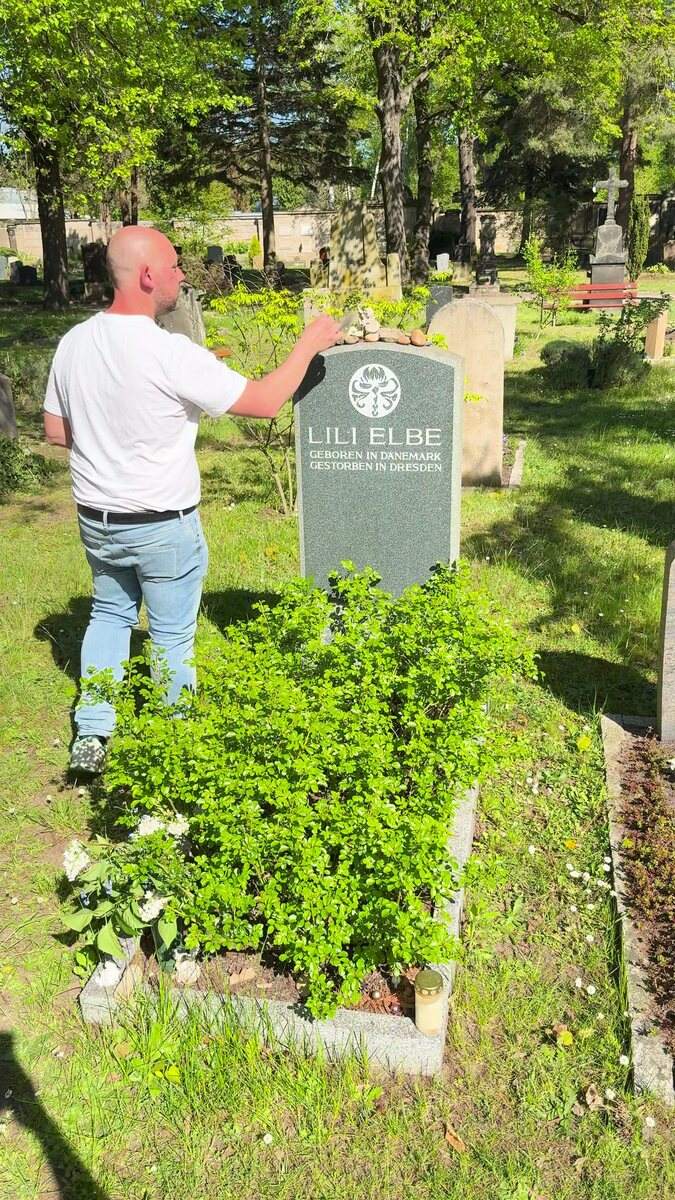
I tried, standing there, to put myself in her place. She went against everything the society of her time believed about who a person could be. She took refusal after refusal, and humiliations I can only guess at, and kept going. And after all of that, what she wanted most required surgery that no one could promise she would survive. She did not.
I was genuinely moved. That is what courage looks like, and what determination looks like, without any of the grand words we usually wrap around them. I thought of how quickly most of us lose heart over things that matter far less, and of how much she had been willing to risk to simply be herself.
What it made me understand is simple: that we owe ourselves a deep kind of love, and that being happy is worth everything it asks of us. Then we moved on.
If you go
Lili’s own journey ran from Berlin to Dresden, and that is the order I would travel it in. Berlin is a city I have known for over twenty years, four months of them as a resident, and my Journal piece What Berlin Holds is about it. In the Tiergarten, Hirschfeld’s Institute stood from 1919 until the Nazis wrecked it in May 1933. Part of that ground is now occupied by the Haus der Kulturen der Welt, whose outdoor space has carried her name since 2023: the Lili Elbe Garden. A memorial on the Magnus-Hirschfeld-Ufer, along the Spree, completes the picture.
Dresden is about two hours south. Give the Lili Elbe grave at the Trinitatisfriedhof an afternoon of its own, with nothing booked afterward, and go with a guide who knows her story well; a street in the city, the Lili-Elbe-Straße, carries her name too. If you want to leave something, leave it small. The pebbles on the stone will tell you that you are not the first.
I would pair it with the river she named herself after: a boat up the Elbe to Loschwitz, past the hillside villas, where a Scottish earl, Lord Findlater, lies buried with his companion. Dresden’s queer history did not begin with her. And for the evening, cross to the Neustadt, where several bars sit a few steps from one another; that is where we ended up on one of our nights there.

This is, almost exactly, the shape of our Berlin & Dresden journey: four nights in Berlin by the Tiergarten, three in Dresden within walking distance of the Frauenkirche, the two cities linked by private car or first-class train as you prefer, and one day given to the Elbe and to Lili’s Dresden with a private guide.
If you would like to stand where I stood, or simply to give Dresden the days it deserves, tell me when you are thinking of going and I will shape the trip around you.
Francesco