
Is Greece gay friendly?
Yes — Greece is a warm, easy country for gay travelers, and it has changed faster than almost anywhere in Europe. In February 2024 it became the first Orthodox Christian country to legalize same-sex marriage, and today it sits 11th of 49 countries in ILGA-Europe’s 2026 Rainbow Map, well above the European average. The honest picture has two sides: Athens and the well-traveled islands are relaxed and international, while a small village is more traditional. What holds it together is something Greeks have a word for — philoxenia, the duty to welcome the stranger — and in my experience it extends naturally to two men traveling together. At Gay Up Travel I plan tailor-made trips across Athens and the Cyclades built around the places, stays and rhythm where you can simply be yourselves.
What the law says
Greece has moved quickly. Same-sex marriage has been legal since February 16, 2024, passed by Parliament 176 to 76, and in 2025 the Council of State, Greece’s highest administrative court, confirmed the law is constitutional. Married same-sex couples can adopt jointly, and marriages performed abroad are recognized. Discrimination at work has been banned since 2005; since 2014 the protection also covers goods and services, alongside a hate-crime law that includes sexual orientation and gender identity.
The gaps are real, and worth knowing. Surrogacy remains closed to male couples, the non-biological parent of a child is not automatically recognized, and ILGA-Europe asks Greece to do more against bias-motivated violence. That is why Greece slipped from 7th to 11th in the 2026 Rainbow Map, with a score of 68% — still firmly in Europe’s upper tier.
What it actually feels like: philoxenia
Here is what the laws don’t tell you. Greeks are hospitable by nature, and our clients feel it everywhere: at the taverna where the owner brings an extra plate, in the small island hotel where check-in feels like dinner with cousins, on the boat where the captain knows which beach is empty that afternoon. In Athens and on the islands travelers actually visit, two men together read as ordinary.
I’ll be honest about the other side, because you should hear it from me. Public opinion is more divided than the law: in the 2023 Eurobarometer, 57% of Greeks supported same-sex marriage, below most of Western Europe. The Orthodox Church still shapes village life, and in a small inland village or a quiet harbor out of season, people are more reserved. In my experience, reserved is not unwelcoming — the welcome you receive as a guest doesn’t change. What changes is how much the room notices you, so there I’d keep affection as discreet as you would in a small town at home.
Athens: where the community gathers
Athens has a sharper, year-round cultural pulse and a large, visible LGBTQ+ community; Athens Pride has filled the city center every June since 2005. The scene isn’t one enclave but a cluster of central neighborhoods a short walk apart:
- Gazi — the city’s main gay nightlife district, around the Technopolis cultural center and Kerameikos metro station. Greek nights start late and run later, often until 4 or 5 a.m.
- Monastiraki and Agia Irini square — the relaxed daytime scene, with cafés and a mixed, queer-friendly crowd a few minutes from the Acropolis.
- Psyrri — street art, alternative bars and plenty of character, between Monastiraki and Gazi.
- Plaka — pedestrian lanes at the foot of the Acropolis, and the calmest, most classic place to stay on a first visit.
Most of the trips I design open with two or three nights in Athens before the islands. Here’s how I shape Athens, Santorini, Naxos and Mykonos into one journey.
The Cyclades, island by island
Beyond Mykonos, the Cyclades are relaxed rather than scene-driven. The smaller islands aren’t about nightlife, and that’s the point: this is the Greece our clients actually want — slow, uncrowded and easy for two.
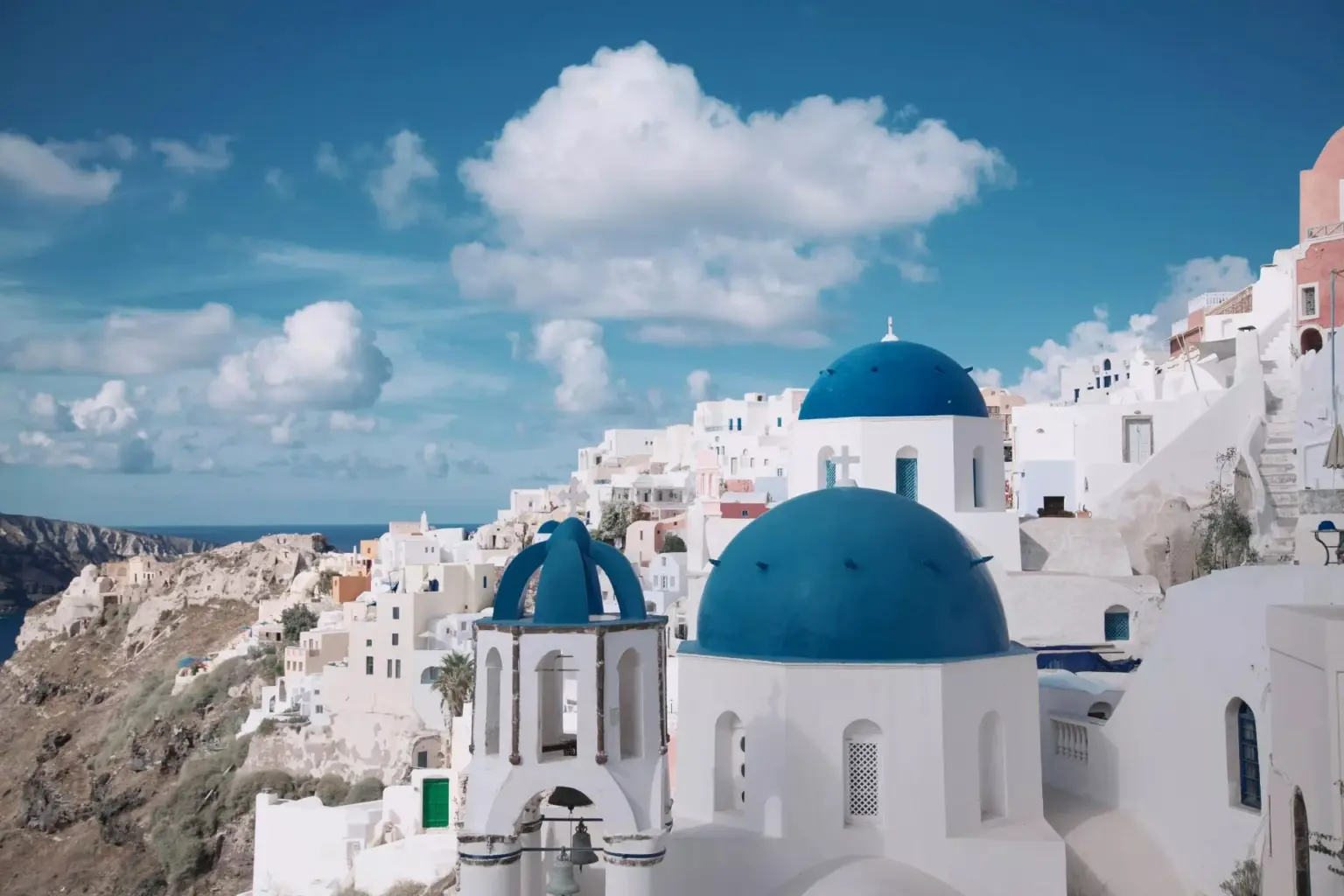
- Santorini brings the drama: caldera views, volcanic wines and a day on the water. It’s international and entirely used to couples of every kind; the only thing to plan around is the summer crowd at the sunset viewpoints.
- Naxos is quieter and greener, with hill villages, long beaches and some of the best local food in the islands — the soul of a Cyclades trip.
- Folegandros is small and unhurried, its main village strung along a cliff edge above the sea. It’s where the welcome feels most personal.
- Milos is all texture: the lunar-white rock of Sarakiniko, fishing villages, and a boat day around coves you can only reach by sea.
The quieter pair makes a journey of its own: the Quiet Cyclades, Folegandros and Milos.
Mykonos: the island’s nights
Mykonos has been a beloved gay destination for fifty years, and it remains the heart of Greece’s summer scene. It isn’t the quiet side of Greece, and I don’t pretend it is — but I do send clients there, and they come back in love with it.
Last September, Ron and Sean ended their trip on Mykonos, front row at a drag show with two queens who went on to compete on RuPaul’s Drag Race. That night they fell in love with the island.
Timing is everything. July and August are when the island is at its most crowded — and exactly the months to come if you’re after its nightlife. For the beaches and the white lanes at a gentler pace, June and September keep much of the energy with far fewer people.
What we tell our clients before they go
- You do not need to hide. In Athens and on the islands I send you to, behave exactly as you would at home.
- In a small village, read the room. Not because you’re unwelcome — because a village square notices everyone.
- Choose the island for the trip you want. Mykonos for the nights; Naxos, Folegandros and Milos for the quiet; Santorini for the view.
- Book stays that were vetted for you. For me, a verified welcome is the first filter, before view or price.
- Shoulder season is Greece at its best — late April to June and September to October bring warm seas and gentler crowds.
FAQs
Is Greece safe for gay travelers?
Yes. Greece is a safe and welcoming country for gay travelers and couples. Same-sex marriage has been legal since 2024, Greece ranks 11th of 49 in ILGA-Europe’s 2026 Rainbow Map, and Athens and the popular islands are relaxed and international. Smaller villages are more traditional, so discretion there is sensible.
Is same-sex marriage legal in Greece?
Yes. Greece legalized same-sex marriage in February 2024, the first Orthodox Christian country to do so. Married same-sex couples can adopt jointly, and marriages performed abroad are recognized.
Where is the gay area in Athens?
Gazi, around Technopolis and Kerameikos metro station, is the main gay nightlife district. Monastiraki and Agia Irini square have a relaxed daytime scene, and Psyrri sits between the two.
When is the best time to visit Mykonos for gay travelers?
July and August for the nightlife, when the island is at its busiest. June and September are calmer, with much of the same energy and far fewer crowds.
Are the smaller Greek islands gay friendly?
Yes. Islands like Naxos, Folegandros and Milos are quiet rather than scene-driven, and couples are welcomed as guests. Village life is more traditional than in Athens or on Mykonos, so affection is best kept discreet in small communities.
If you’re imagining Greece as a couple — Athens, the quiet Cyclades or a few nights on Mykonos — tell me what you have in mind and I’ll shape it around you. I read every message myself. — Francesco