
Ireland, carved in stone and weather
When to go
May / June — September / October
Ideal length
9 — 11 nights
Price
From $8,625 pp (flights not included) (based on double occupancy)
The trip in a nutshell
Eleven days, five anchor towns, a single diagonal cut across the island — from Dublin’s literary east, through a spa estate in Wexford, down to the harbor light of Kinsale, west into the Kerry peninsulas, and up the Atlantic coast to Galway and Connemara. No transfer hotels, no single-night stops, no rushing. You stay two nights in every place, and you travel with a private driver-guide who knows where the good side of each valley is.
The thread I care most about is the storytelling. Ireland is often sold as castles and shamrocks, and that’s not the country. It’s a place of weather, language, centuries of exile and return, and a queer cultural history that runs from Oscar Wilde’s Merrion Square to the same-sex marriage referendum of 2015 — the first country in the world to legalize it by popular vote. We open the trip in Dublin with a private queer history walk, led by a local team who tell that history with the care it deserves and set the lens for everything that follows. From there, we let the land and the food do the work.
What we take care of

A tailor-made itinerary, built around your pace

Handpicked hotels in the right neighborhoods

Local experts, guides and key reservations

Private door-to-door transfers

Experiences designed around you, never a checklist

24/7 support — before and during your trip
Who this is for
Ireland rewards a particular kind of attention. If you like a long meal more than a long drive, if you’d rather sit in a kitchen than at a panorama restaurant, if you read Colm Tóibín on the plane and pack a jacket because you’ve heard the Atlantic has opinions — this trip is going to feel like it was made for you.
Two-night stays in every place. Country estates and harbor towns more than cities. Mornings without a hurry, afternoons that earn themselves, evenings that turn into long ones. Ireland gives back what you give it.
And the welcome here is one of the warmest in Europe — not because anyone is trying, but because they’re not trying at all. It’s in the way a room turns toward you when you walk in, in the conversations that start with strangers and finish hours later. The queer history walk we open with in Dublin sets the lens for everything that follows: Wilde’s Merrion Square, the writers we’ll read on the road, the openness of the people we’ll meet along the way.
Sample itinerary
A representative eleven-day flow. Every itinerary is rebuilt around your dates, pace, and interests.

DAY 1 — Dublin | Georgian arrival, first dinner
Your driver meets you at arrivals and takes you through the Georgian squares into the city. Check-in at The Davenport, a four-star converted church on Merrion Square — which is worth saying out loud, because Merrion Square is where Oscar Wilde grew up, and your hotel is thirty seconds from his childhood front door. You have the afternoon to settle in and walk the square before dinner. I usually book tables at Pichet for the first night — Bib Gourmand, a few minutes’ walk, and exactly the right register to start: warm, confident, unfussy.
DAY 2 — Dublin | A queer history walk
The morning is given over to a private queer history walk through the city. This is the component I’m most particular about. Rather than retrofitting a queer layer onto a generic city tour, we work with a local team already telling this history with the care it deserves — from Wilde’s Merrion Square to Trinity College, from the decriminalization campaign of the 1990s to the 2015 referendum. Afternoon is yours: Trinity College’s Long Room and the Book of Kells, or the Guinness Storehouse if you’d rather see how a city drinks. Evening: Chapter One for the Michelin experience, or Hawksmoor if you want a steak done properly in a country that finally knows how.
DAY 3 — Wicklow & Wexford | South through the monasteries
You leave Dublin mid-morning with your driver-guide and head south into County Wicklow. First stop is Glendalough — an early-Christian monastic settlement in a glacial valley, two lakes stacked one above the other, a round tower from the tenth century. The kind of place where the landscape does the talking. Then Powerscourt Waterfall, Ireland’s tallest at 121 meters, before arriving at Monart in Wexford in the late afternoon. Adults-only, five stars, 100 acres of beech forest around it. Check in, change, book a treatment, eat at the hotel restaurant. Tonight is early.
DAY 4 — Nothing on the schedule but Monart
This is the day you thank me for. No driving, no itinerary — just a full day at Monart. The thermal suite, the salt room, the outdoor hot tub in the woods, two treatments if you’re wise. Lunch in-house, a long afternoon with a book by the lake, dinner at The Restaurant (tasting menu if you want it). I elevated Monart to two nights because a destination spa done in one feels like a lobby you passed through. Two nights is how it becomes the trip’s pause.
DAY 5 — Cobh & Kinsale | Emigration, the Atlantic, a harbor
Check out after breakfast. You drive west and your first stop is Cobh, on the south coast — the town with the row of candy-colored houses climbing up the hill, and the last port the Titanic called at before sinking. More importantly, Cobh was the departure point for millions of Irish emigrants to America in the nineteenth century; the small Heritage Centre tells that story with unusual restraint. From there, a short drive west along the coast brings you into Kinsale in the late afternoon. Check in at the Trident, harbor-front. Dinner tonight at Bastion — Kinsale’s Michelin restaurant, small room, tasting menu, one of the reasons Kinsale calls itself Ireland’s gourmet capital and means it.
DAY 6 — Kinsale | Food, gardens, the Atlantic up close
A quieter day. Morning: a three-hour guided food walk with a local who takes you through fishmongers, cheese rooms, a chocolate maker, and a pub where they cure their own fish. This is the part of the trip where you stop thinking about what Ireland should be and start noticing what it actually is. After lunch: the Ringfinnan Garden of Remembrance — 343 trees planted by a Kinsale nurse, one for each New York firefighter lost on 9/11. It’s the quietest place in West Cork. Dinner: Finns’ Table, two minutes from your hotel, ingredients from the farm the family runs twenty minutes inland.
DAY 7 — Kinsale to Kenmare | Into the mountains
You cross into County Kerry this morning. En route, we stop at a buffalo farm in West Cork — the farmer who runs the place leads us through the herd, and a chef sets up tastings in the farmhouse kitchen. You eat buffalo mozzarella made two meters from where it was milked. After lunch: St Finbarr’s Oratory at Gougane Barra, a nineteenth-century chapel on an island in a still lake ringed by mountains. Arrival at Sheen Falls Lodge, on the edge of Killarney National Park, by late afternoon. The Lodge is a five-star on a 300-acre estate with a waterfall in the grounds — quietly one of the best hotels in Ireland. Dinner in-house.
DAY 8 — Dingle Peninsula | The edge of Europe
The best day of the trip, if the weather agrees. Your driver takes you onto Slea Head Drive — the coastal loop of the Dingle Peninsula, the westernmost point of mainland Europe. The itinerary is elastic: beehive huts from the early Christian period, Gallarus Oratory (a sixth-century stone chapel still standing), famine cottages open to the Atlantic. Lunch in Dingle Town at The Fish Box or Out of the Blue — both family-run, both seafood, both the reason people come here. A short walk up from Dunquin Pier looks out over the Blasket Islands, and on a clear day it’s the most Irish view Ireland will give you. Back to Sheen Falls by evening.
DAY 9 — Cliffs of Moher & the Burren | The long drive north
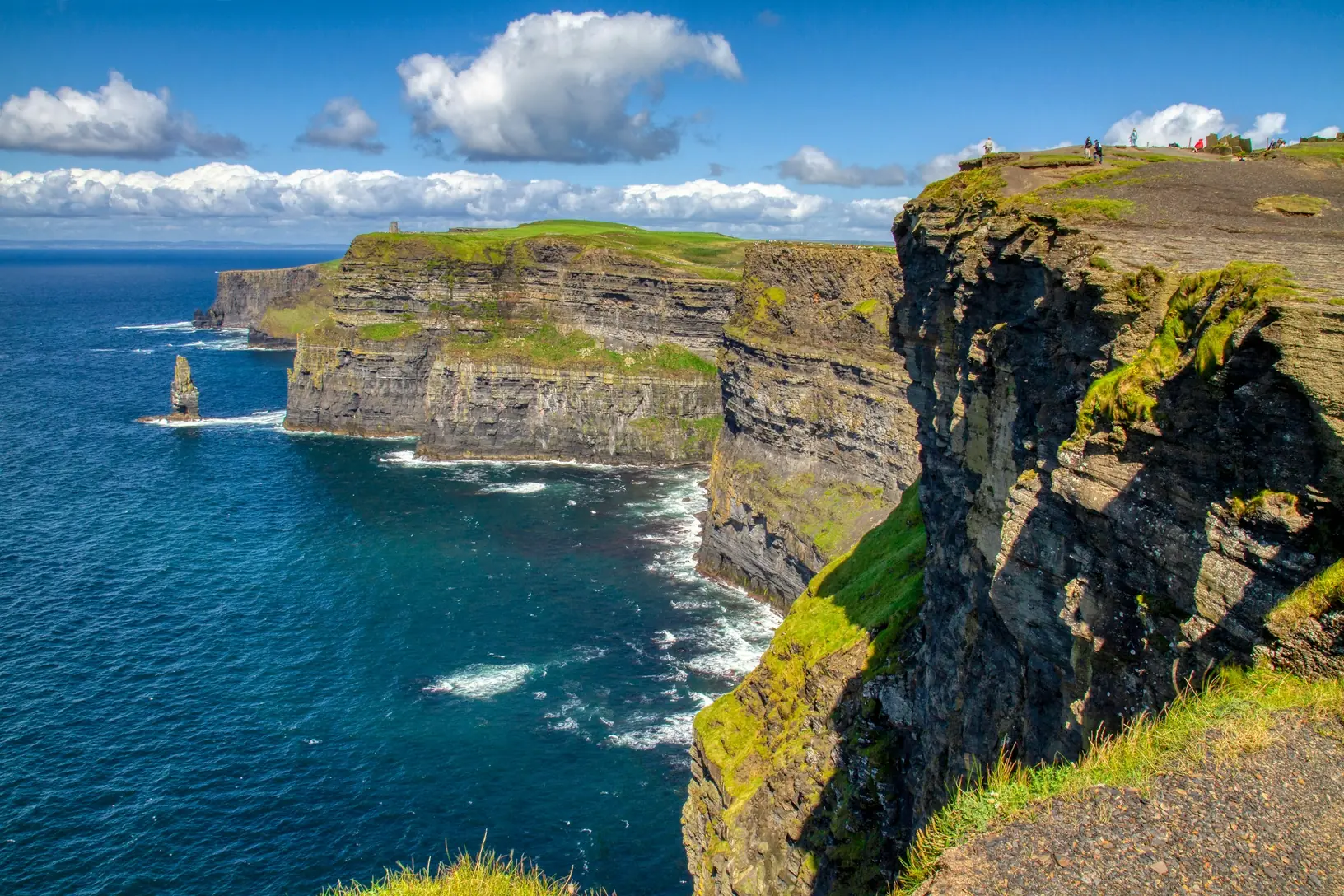
The longest driving day — seven hours total, broken by stops that earn it. The Tarbert–Killimer car ferry across the Shannon estuary saves an hour and gives you the crossing as part of the day. Then the Cliffs of Moher, which deserve their reputation: eight kilometers of cliff-edge on the Wild Atlantic Way, some of the tallest sea cliffs in Europe. Lunch in Doolin. The afternoon takes you through The Burren — a limestone karst landscape unlike anything else in Ireland — with stops at the Poulnabrone Dolmen (a portal tomb from 4000 BC) and a sheepdog demonstration on a working sheep farm if you want to see how the West works the land. Arrival at Glenlo Abbey in Galway by evening, on the shore of Lough Corrib.
DAY 10 — Connemara | Abbey, oysters, music
Connemara is what people mean when they say “the west of Ireland.” Your driver takes you through it: Kylemore Abbey, a Victorian monastery that became a Benedictine house, against a lake and the Twelve Bens mountains. Lunch at a private oyster farm on Killary Fjord — closed to the general public, our driver has the booking. Back in Galway by late afternoon. Dinner tonight at Kai — the best restaurant in the city, warm and honest, with a wine list that rewards asking the staff. End the evening at Tigh Neachtain or The Crane for live trad music: not the tourist version, the real one.
DAY 11 — Departure | Shannon or Dublin
Your driver takes you to the airport. Shannon is an hour and fifteen; Dublin is two and a half hours east across the country. Depending on your onward flight, we plan accordingly — and if you want an extra night in Dublin to book a show at the Abbey Theatre or pick up anything at Avoca on the way home, we add it.
Hotels we love
Five properties, five different registers of Irish hospitality. We match each one to your trip — never all five in one go.

The Davenport · Dublin
A four-star Georgian landmark on Merrion Square, seconds from Oscar Wilde’s childhood home and a few minutes’ walk from Trinity College. The new Bask thermal spa is a real addition — a rare thing in central Dublin. The rooms are generous, the staff are unfussy, and the location does the heavy lifting. The right first impression of the city.

Monart · Wexford
A five-star destination spa on 100 acres of Wexford beech forest — adults-only, quiet enough that you notice the quiet. Fifteen treatment rooms, a thermal suite built around light and water, and a restaurant that deserves the tasting menu. This is the property we stay at for two nights, not one. The difference is the reason we book it.

The Trident · Kinsale
Four stars, directly on Kinsale harbor — the room with the water view is the one you want. This is not a grand hotel; it’s a well-run harbor-front property that puts you two minutes from every Michelin restaurant in town. Kinsale is a walking village, and the Trident is where you walk from.

Sheen Falls Lodge · Kenmare
Five stars, 300 acres, a waterfall on the grounds and Killarney National Park through the window. A country estate run the old way, but without the stuffiness — the staff are Kerry, which is to say warm. This is the property for the Kerry leg of the trip, and there is no equivalent in the region.

Glenlo Abbey · Galway
Five stars, on the shore of Lough Corrib, fifteen minutes from Galway city. An eighteenth-century abbey converted without losing its bones; the Pullman restaurant is set inside two original Orient Express railway carriages parked on the estate, which sounds gimmicky and isn’t — it’s Michelin, and the novelty stops at the walls. The final pause before the Atlantic becomes an airport.
Make this itinerary yours
Tell us your dates, pace and hotel style — and within 48 hours we’ll come back with a tailored version of this itinerary.